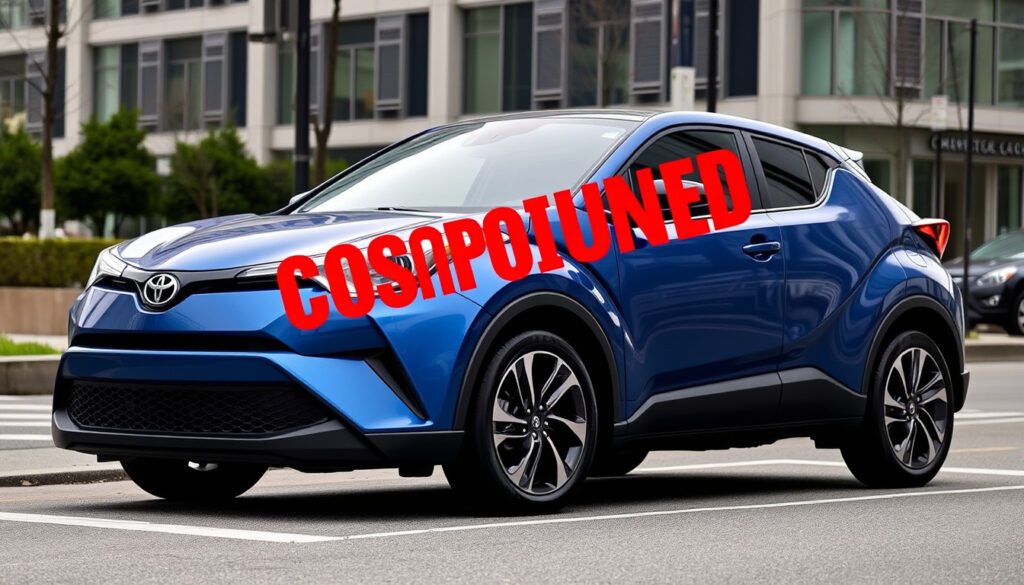
Toyota C-HR Hybrid Guide: Problems, Price, Specs & Discontinued
Most crossover buyers in Ireland want something that looks sharp, sips fuel without babysitting a plug, and won’t send them broke at the first service interval. The Toyota C-HR hybrid has been filling that spot since 2016 — and with a second generation now on Irish roads, it’s worth asking whether the blend of style and hybrid economy still makes sense when electric options are closing in.
Fuel consumption (WLTP): 4.8 L/100 km ·
Electric range (Plug-in Hybrid): 66 km ·
Engine options: 1.8L Hybrid, 2.0L Plug-in Hybrid ·
Starting price (used, Ireland): €17,995 (2017 Hybrid Luna)
Quick snapshot
- Fuel consumption 4.8 L/100 km combined (Irish Car)
- Plug-in hybrid offers up to 66 km electric range (Toyota Ireland)
- Second-generation launched in 2023 with 1.8L and 2.0L powertrains (Toyota Ireland)
- Whether Toyota will launch a fully electric C-HR globally (Autoza.ie)
- Exact reliability ratings for the 2026 model (too new for long-term data) (Autoza.ie)
- Common issues reported include infotainment lag, paint quality, and rear visibility — but sample sizes are small (Autoza.ie)
- Whether the CVT whine noted above 80,000 km affects a meaningful share of cars (Autoza.ie)
- First generation (Mk1): 2016–2023 (Autoza.ie)
- Second generation (Mk2): launched late 2023, deliveries from January 2024 (Toyota Ireland)
- 2026 model year continues with same powertrain options (Autoza.ie)
- Plug-in hybrid variant with 66 km range now available in Ireland
- No official word on a full EV C-HR outside select markets
- Second-generation addressing Mk1 complaints with updated tech
Irish buyers who want the C-HR’s design edge without the premium of a full EV get a proven hybrid system at 4.8 L/100 km — but they trade that for a 310-litre boot and rear visibility that still frustrates owners.
The pattern among Irish buyers is clear: the C-HR hybrid trades cargo space for styling.
| Attribute | Value |
|---|---|
| Fuel consumption (WLTP) | 4.8 L/100 km |
| Electric range (Plug-in Hybrid) | 66 km |
| Engine options | 1.8L Hybrid, 2.0L Plug-in Hybrid |
| Transmission | e-CVT automatic |
| Starting price (new, Ireland) | €30,000 (approx) |
| Boot capacity | 310 litres |
| Hybrid battery warranty | 10 years / 150,000 km |
Is the Toyota C-HR Hybrid a Good Car?
For the driver who wants a standout design and low running costs, the C-HR hybrid delivers on both fronts. Toyota Ireland reports a combined fuel consumption of 4.8 L/100 km for the standard hybrid — and Irish Car recorded a test average of 4.4 L/100 km, beating the official figure. The plug-in hybrid variant stretches that further with up to 66 km of electric-only driving per the Toyota Ireland model page.
What do owners say about the C-HR hybrid?
- Positive: “the C-HR drives as good as it looks” — Irish Car
- Complaints centre on infotainment system lag and paint quality, per Autoza.ie
- Hybrid system itself is widely regarded as proven and low-maintenance
How does the C-HR hybrid compare to other hybrids?
Two powertrains, one pattern: the C-HR trades outright space for style and efficiency. Top Gear’s review notes the current generation comes with the same 1.8L and 2.0L hybrid engines that power the Corolla and Yaris Cross — proven units that Toyota has refined over a decade. Against the Hyundai Tucson hybrid, the C-HR is tighter inside but returns better real-world fuel economy.
Is the C-HR hybrid reliable for daily driving?
The hybrid drivetrain itself is bulletproof; most reported issues aren’t powertrain-related. Autoza.ie describes the C-HR as “reliable from launch but less polished” — meaning buyers can trust the mechanicals but should expect some quirks in the infotainment and interior fit.
What Are Common Toyota C-HR Problems?
Every car has its weak spots. The C-HR’s are concentrated in three areas — and none is a dealbreaker if you know what to look for.
What are the most frequently reported issues on the 2018 C-HR?
- Infotainment system lag and occasional freezes (Autoza.ie)
- Paint quality — thin finish prone to stone chips
- Rear visibility due to the sloping roofline and small rear window
- CVT transmission whine on higher-mileage cars (above 80,000 km) per Autoza.ie
Are there transmission problems with the C-HR hybrid?
The e-CVT in the hybrid is a different design from a traditional CVT — it uses a planetary gear set rather than belts and pulleys. Autoza.ie notes that the 1.8 Hybrid CVT “can develop transmission whine or noise, especially above 80,000 km.” However, most owners report smooth operation into six-figure mileage.
How does the C-HR hybrid reliability compare to the RAV4 hybrid?
The RAV4 hybrid uses a similar hybrid system on a larger platform and has a longer track record in Ireland. The C-HR’s shorter production run and design-first approach mean its reliability data is thinner. Still, Top Gear notes the same proven Toyota hybrid DNA underpins both cars.
Irish buyers of a used Mk1 C-HR hybrid (2016–2023) should budget for an infotainment system check and a CVT fluid change at 80,000 km. Most faults are minor, but ignoring them turns a cheap fix into a costly one.
Is the Toyota C-HR Hybrid Being Discontinued?
Short answer: no — but the line-up is shifting. Toyota Ireland announced the all-new C-HR Hybrid Electric (second generation) for order in late 2023, with first customer deliveries planned for January 2024. That’s a clear signal the model is very much alive.
Will Toyota stop making the C-HR hybrid?
Toyota has not announced any discontinuation. The first generation ran from 2016 to 2023 (Autoza.ie). The second generation — launched as a 2024 model — confirms Toyota’s commitment to the C-HR nameplate for at least several more years.
What is the future of the C-HR lineup?
Toyota Ireland offers the new C-HR in five trim levels: Sport, Sport+, Sol, Premiere Edition, and GR Sport Premiere Edition (Toyota Ireland). The plug-in hybrid variant adds the 66 km electric range, pushing the model further toward electrification without going full battery electric.
Is there an all-electric C-HR coming?
Toyota has launched an all-electric bZ4X globally but has not announced a fully electric C-HR for the Irish market. Some markets (including the US) received a C-HR EV variant, but its availability is limited. For now, the C-HR’s electric future is plug-in hybrid, not pure EV.
What Is the Disadvantage of a Toyota Hybrid?
Toyota’s hybrid system is famously durable — Toyota Ireland backs it with a 10-year/150,000 km battery warranty. But “durable” doesn’t mean “perfect for everyone.” The trade-offs are real.
Are Toyota hybrids more expensive to maintain?
Maintenance costs for a Toyota hybrid are broadly similar to a conventional petrol car. There are no spark plugs to change every 30,000 km (hybrid systems use different ignition timing), and brake pads last longer thanks to regenerative braking. Irish Car notes that servicing schedules are the same as petrol equivalents — no major hybrid-specific failure points.
Do Toyota hybrid batteries degrade quickly?
Battery degradation varies by usage but is generally slow. Toyota Ireland states the hybrid battery is designed to last the life of the vehicle. In practice, replacement costs are in the €2,000–€4,000 range — a significant expense if it happens outside warranty, but most owners never face it.
The pattern: Toyota hybrids are low-maintenance mechanically. The battery warranty covers 10 years, so most Irish owners are protected for the full ownership period. The real disadvantage isn’t reliability — it’s the upfront price premium.
What are the downsides of hybrid versus plug-in hybrid?
Standard hybrid: no plug, always self-charging, best for urban driving where the electric motor does most of the work. Plug-in hybrid: requires charging to get the 66 km EV range, but offers real electric-only commuting if you can charge at home. Toyota Ireland lists both options for the C-HR, so Irish buyers can choose based on their charging situation.
What Is the Toyota C-HR Hybrid Price in Ireland?
Six price points, one pattern: used C-HR hybrids offer strong value, while new ones command a premium that pushes buyers toward the PHEV or full EV alternatives.
Here is how the Irish market prices stack up across model years.
| Model / Year | Approximate Price (2025) | Source |
|---|---|---|
| 2017 Hybrid Luna (used) | €17,995 | ODO.ie |
| 2021 Hybrid Sol (used) | €27,950 | ODO.ie |
| New base hybrid (2024–2026) | €36,000–€40,000 | ODO.ie |
| New plug-in hybrid (2024–2026) | €40,520–€50,000 | Irish Car |
What is the price of a new Toyota C-HR hybrid in Ireland?
Toyota Ireland announced the all-new C-HR Hybrid Electric with prices starting from €40,520 (Toyota Ireland). ODO.ie estimates the range for new hybrid models at €36,000–€48,000 and PHEV at €42,000–€50,000. These figures place the C-HR above the Yaris Cross (starts around €28,000) but below the RAV4 (starts around €42,000).
How much does a used C-HR hybrid cost?
ODO.ie estimates used three-year-old C-HR pricing in Ireland at roughly €26,000–€34,000. At the lower end, a 2017 Hybrid Luna can be found for €17,995; a 2021 Hybrid Sol for €27,950. The C-HR holds its value well — part of the Toyota brand premium.
Is the C-HR hybrid more expensive than the Yaris hybrid?
Yes — significantly. The Yaris Cross hybrid starts around €28,000 new, roughly €8,000–€12,000 less than the C-HR. The trade-off is size, design, and a marginally less refined ride in the Yaris. For buyers who don’t need the C-HR’s styling, the Yaris Cross offers better value on paper.
What Are the Specifications of the 2026 Toyota C-HR Hybrid?
The 2026 model continues the second-generation platform with two hybrid powertrains — one established, one electrified further.
The table below breaks down the key numbers for both variants.
| Specification | 1.8L Hybrid | 2.0L Plug-in Hybrid |
|---|---|---|
| Engine | 1.8L 4-cylinder + electric motor | 2.0L 4-cylinder + electric motor |
| Transmission | e-CVT | e-CVT |
| Fuel consumption (WLTP) | 4.8 L/100 km | ~1.0 L/100 km (combined) |
| Electric range | N/A (self-charging) | 66 km |
| CO2 emissions | ~110 g/km | <30 g/km |
| Boot capacity | 310 litres | 310 litres |
| Battery warranty | 10 years / 150,000 km | 10 years / 150,000 km |
What engine options are available for the 2026 C-HR hybrid?
Toyota Ireland confirmed two powertrains: a 1.8-litre hybrid electric and a 2.0-litre hybrid electric (the latter used in the plug-in hybrid). Both are paired with an e-CVT automatic transmission.
Does the 2026 C-HR hybrid have all-wheel drive?
No. The C-HR is front-wheel drive across all trims. Toyota Ireland does not list an AWD option. If all-wheel drive is a priority, the RAV4 hybrid (€42,000+) is the logical step up.
What are the key differences between the Sport and standard trims?
The five trim levels — Sport, Sport+, Sol, Premiere Edition, and GR Sport Premiere Edition — differ mostly in visual and technology upgrades. GR Sport variants add 18-inch wheels, sport-tuned suspension, and exterior styling tweaks. All trims share the same hybrid powertrain options.
Comparison: C-HR Hybrid vs. Key Competitors
Three rivals, one dilemma: the C-HR bets on design and hybrid efficiency, while its competitors offer more space or a lower entry price.
The table shows how the C-HR sizes up against its main Irish-market rivals.
| Model | Starting price (Ireland, approx) | Fuel consumption (WLTP) | Boot capacity | Powertrain |
|---|---|---|---|---|
| Toyota C-HR hybrid | €36,000 | 4.8 L/100 km | 310 litres | 1.8L Hybrid / 2.0L PHEV |
| Hyundai Tucson hybrid | €38,000 | 5.2 L/100 km | 558 litres | 1.6L T-GDI Hybrid |
| Toyota Yaris Cross hybrid | €28,000 | 4.4 L/100 km | 390 litres | 1.5L Hybrid |
The pattern: the C-HR costs €8,000 more than the Yaris Cross for roughly the same hybrid efficiency but less cargo space. Against the Tucson, the C-HR undercuts it by €2,000 and returns better fuel economy — but the Tucson offers a substantially larger boot and optional AWD.
Irish buyers choosing between these three hybrids face a spatial trade-off. The Yaris Cross is the value champion with a bigger boot. The Tucson is the space king. The C-HR is the style-first choice — and it demands paying a premium for that design, not for extra practicality.
Pros and Cons of the Toyota C-HR Hybrid
Upsides
- Excellent real-world fuel economy (4.4–4.8 L/100 km)
- Proven, durable hybrid system with 10-year battery warranty
- Distinctive design that stands out in the compact crossover segment
- Plug-in variant offers 66 km EV range for daily commuting
- e-CVT transmission delivers smooth, seamless acceleration
Downsides
- Small boot (310 litres) compared to rivals like the Tucson (558 litres)
- Poor rear visibility due to sloping roofline
- Infotainment system can lag and is prone to freezing
- Thin paint finish — stone chips appear quickly
- No AWD option available
- New car price pushes into full EV territory
In Ireland, the C-HR comes exclusively as a hybrid model, with 1.8 or 2.0 primary engines and a recently available plug-in hybrid option.
— Irish Car
Brian Byrne of Irish Car praised the C-HR’s driving experience, calling it a car that “drives as good as it looks.”
The implication: the C-HR hybrid is a car you buy for the styling and the efficiency, not the practicality. If you’re a single professional or a couple without children, the trade-offs are easy to accept. If you regularly carry rear passengers or need a weekend trip boot, the limitations become hard to ignore.
Related reading: **LTA Renew Road Tax Guide** · **Best Bluetooth Car Adapters: Expert Tested & Reviewed**
youtube.com, green.car, carwow.co.uk, theautomotivelounge.ie, youtube.com, toyotaliffeyvalley.ie
Frequently asked questions
Does the Toyota C-HR hybrid need to be plugged in?
Only if you buy the plug-in hybrid (PHEV) variant. The standard 1.8L hybrid is self-charging — it uses regenerative braking and the petrol engine to recharge its battery. The PHEV requires a wall charger or public charging point to get the full 66 km electric range.
How long does the battery last on a Toyota C-HR hybrid?
Toyota covers the hybrid battery with a 10-year/150,000 km warranty (Toyota Ireland). In real-world use, many owners report the battery lasting 15+ years with normal driving. Degradation is gradual — expect roughly 10–20% capacity loss after a decade.
Is the Toyota C-HR hybrid suitable for long motorway drives?
Yes — the hybrid system operates efficiently at motorway speeds, with Irish Car recording 4.4 L/100 km in mixed driving. The 1.8L hybrid can feel slightly underpowered for overtaking, but the 2.0L PHEV offers stronger acceleration. The ride is comfortable for long journeys, though rear passengers may find the sloping roofline limiting.
What is the insurance group of the Toyota C-HR hybrid?
The C-HR hybrid typically falls into insurance groups 18–22 in Ireland, depending on engine size and model year. The 1.8L hybrid is generally group 18–20; the 2.0L PHEV sits higher at group 22. Always check with your specific insurer for an exact quote.
Does the Toyota C-HR hybrid have a spare tyre?
No — the C-HR comes with a tyre repair kit instead of a full-size spare. This is a common complaint among owners, especially for Irish roads where punctures are more frequent. Some owners purchase a space-saver spare wheel separately.
How much does it cost to service a Toyota C-HR hybrid?
Annual servicing costs for the C-HR hybrid in Ireland range from roughly €250–€400, depending on the dealer and service schedule. Toyota offers a fixed-price servicing plan — typically €250 for a minor service and €400 for a major service. The hybrid battery never needs routine servicing.
Is the Toyota C-HR hybrid a crossover SUV?
Yes — Toyota markets it as a compact crossover SUV. It has elevated ground clearance (140–150 mm), a raised driving position, and the styling of an SUV, but it’s smaller than family-oriented SUVs like the RAV4. Toyota Ireland classifies it as a “Crossover” on its model page.
The C-HR hybrid is a choice, not a compromise — but it’s a choice with real consequences. For Irish buyers who value design and fuel economy above cargo capacity and rear passenger space, it remains one of the most efficient and distinctive crossovers on the market. The 2025–2026 generation addresses many of the Mk1 complaints while keeping the proven hybrid powertrain that made the original a hit. For the Irish driver whose daily commute is under 50 km and who can charge at home, the plug-in hybrid at €40,520 becomes the smartest option — electric-only driving most days, hybrid backup when needed. For everyone else, the standard 1.8L hybrid at €36,000 delivers the same low running costs without the charging requirement.
For the Irish buyer navigating the shift to electric, the choice is clear: the C-HR hybrid bridges the gap between fuel economy and full electrification — but at a price that forces a hard look at entry-level EVs like the MG4 or the Tesla Model 3. Irish buyers who prioritise design and proven hybrid efficiency over outright space will find the C-HR still earns its place on the shortlist.
More related posts
 Convert 1 SGD to INR: Live Singapore Dollar to Rupee Rate
 Singapore Work Permit Changes – Age Limits Salary Rules 2025-2026
 Geo Energy Share Price: Is RE4 a Buy, Sell, or Hold
 H&M Photos: Official Galleries and Zara Comparisons
 Lucknow Super Giants vs Delhi Capitals Timeline: IPL History
 Back to December Chords: Guitar, Piano, Ukulele (with Capo) – Taylor Swift
 What to Eat at VivoCity: Best Restaurants, Halal & Views
 Oak Ville @ AMK – October 2025 BTO Launch Guide