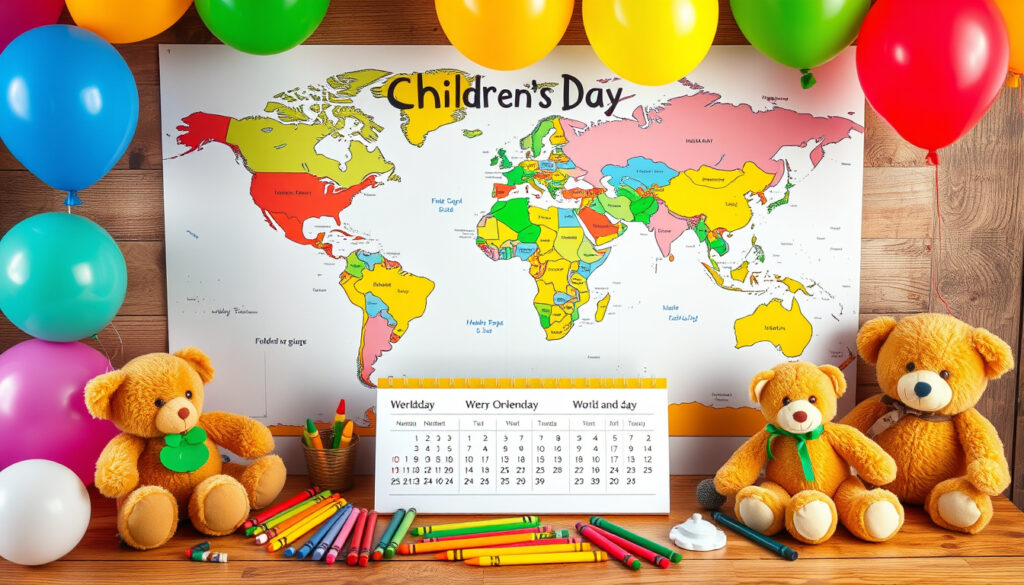
When is Children’s Day? Dates in Ireland & Worldwide
The date you mark for Children’s Day depends entirely on where you live. While Ireland follows the UN’s Universal Children’s Day on 20 November, countries like China and Russia celebrate on 1 June instead. This variation reflects different historical roots—one tied to the UN’s children’s rights milestones, the other to a 1950 initiative by the Women’s International Democratic Federation.
World Children’s Day date: 20 November ·
Established by: UN General Assembly 1954 ·
Ireland observance: 20 November ·
UN Declaration issuance: 20 November ·
UNICEF focus: Children’s rights
Quick snapshot
- World and Ireland observe on 20 November (Wikipedia comprehensive date table)
- UN established Universal Children’s Day in 1954 (Scoilnet UN timeline)
- Exact date in all countries varies by source
- Whether “today” qualifies depends on your calendar
- 1925: First International proclamation (Wikipedia historical record)
- 1954: UN establishes Universal Children’s Day (Scoilnet educational resource)
- 20 November: Annual observance (Wikipedia date reference)
- 2025 World Children’s Day on 20 November (Scoilnet upcoming events)
- Ongoing promotion of children’s rights globally (UNICEF Ireland advocacy)
When is Children’s Day in Ireland?
Ireland celebrates Universal Children’s Day on 20 November each year, aligning with the date established by the United Nations. The Irish Ombudsman for Children’s Office has organised events for this observance, including celebrations in 2017 with the Department of Children and Youth Affairs. (Ombudsman for Children Ireland official)
Ireland participates alongside countries including Canada, France, and the UK, all following the UN-aligned November date. (Wikipedia international comparison) The National Parents Council Ireland promoted events for World Children’s Day on 20 November in 2019, demonstrating continued engagement with the observance. (National Parents Council Ireland news)
The implication for Irish families is straightforward: the official observance date is 20 November, and participation through school events or community activities aligns the country with global children’s rights advocacy.
World Children’s Day on 20 November
Blue is the symbolic colour for children’s rights on World Children’s Day, representing the global effort to protect and promote children’s welfare. (Childline Ireland symbolism)
Is Children’s Day the first of June?
Many countries, including China, Russia, and former Eastern Bloc nations, celebrate Children’s Day on 1 June following a 1950 suggestion by the Women’s International Democratic Federation. (Wikipedia Eastern Bloc tradition) This date is common across Asia and Eastern Europe but is not universal.
In China specifically, Children’s Day on 1 June is a major national holiday with widespread celebrations, school performances, and family outings. (Wikipedia China coverage)
The pattern reveals a Cold War-era split that persists today: Soviet-aligned nations inherited the 1 June date, while Western countries gravitated toward the UN-established 20 November.
International variations
The choice between 1 June and 20 November often reflects Cold War-era divisions, with Soviet-aligned nations adopting the Eastern Bloc tradition while Western countries generally follow the UN date.
Which day is children’s day today?
Whether today is Children’s Day depends entirely on your location. In Ireland and most countries observing the UN date, the answer applies only on 20 November. In China and Russia, the relevant date is 1 June. In India, Children’s Day falls on 14 November. (Wikipedia global variations)
What this means for families: checking the calendar against national observance dates prevents missed celebrations and ensures children receive recognition on the appropriate day.
Check current date against observances
If you’re checking whether today qualifies, cross-reference your country against the regional patterns: UN-aligned nations use 20 November, Eastern Bloc-influenced countries use 1 June, while Latin American nations have their own dates such as Brazil’s 12 October celebration. (Wikipedia Latin American dates)
There is no single “today is Children’s Day” answer globally. Families moving between countries need to track their destination’s specific date to participate appropriately.
What is World Children’s Day?
World Children’s Day, also called Universal Children’s Day, was established by the United Nations General Assembly in 1954 and is celebrated annually on 20 November. (Scoilnet official source) The day promotes international togetherness, awareness among children worldwide, and improving children’s welfare.
The 20 November date carries particular significance as it marks two major UN milestones: the 1959 adoption of the Declaration of the Rights of the Child and the 1989 adoption of the Convention on the Rights of the Child. (Scoilnet UN milestones)
UNICEF role
UNICEF Ireland leads awareness campaigns for World Children’s Day, emphasising children’s rights and encouraging community participation. (UNICEF Ireland campaigns)
Activities
Common World Children’s Day activities include school events, community gatherings, and educational programmes focused on children’s rights awareness. (Childline Ireland activities)
The implication is that World Children’s Day serves as both a celebration and a rights-awareness vehicle, linking childhood recognition to UN-backed declarations.
Why is Children’s Day celebrated?
Children’s Day commemorates the adoption of child welfare declarations and celebrates childhood itself. Universal Children’s Day promotes international togetherness and children’s welfare. (Childline Ireland purpose)
History and purpose
International Children’s Day was first proclaimed in 1925 in Geneva. The United Nations later established Universal Children’s Day in 1954 to create a globally coordinated celebration of children’s rights. (Wikipedia historical context)
The pattern shows that Children’s Day evolved from a localised proclamation into a globally coordinated observance, reflecting growing international commitment to children’s welfare.
| Country/Region | Children’s Day Date | Notes |
|---|---|---|
| Ireland | 20 November | UN-aligned Universal Children’s Day |
| China | 1 June | Eastern Bloc tradition from 1950 |
| India | 14 November | Honours Jawaharlal Nehru’s birthday |
| Turkey | 23 April | National Sovereignty and Children’s Day |
| Japan | 5 May | Children’s Day holiday |
| Brazil | 12 October | Officially approved in 1924 |
| Russia | 1 June | Eastern Bloc tradition |
| Mexico | 30 April | National observance |
| United Kingdom | Second Sunday of May | Sunday celebration |
| Nigeria | 27 May | National Children’s Day |
| Germany/Austria | 20 September | Regional observance |
| Thailand | Second Saturday of January | Weekend celebration |
The table reveals the patchwork of global observances: twelve countries with distinct dates, showing how national priorities and historical connections shape each celebration.
Children’s Day around the world
The global picture shows three main regional patterns. UN-aligned nations including Ireland, most of Western Europe, and many Arab countries observe 20 November. (Wikipedia UN-aligned nations) Eastern Bloc-influenced countries including China, Russia, and former Soviet states celebrate 1 June. Latin American nations have varied dates—Brazil on 12 October, Mexico on 30 April, Argentina and Peru on the third Sunday of August.
Some countries have unique dates tied to local history. India celebrates 14 November to honour Jawaharlal Nehru, who was beloved by children. (Wikipedia India coverage) Turkey’s National Sovereignty and Children’s Day on 23 April commemorates national independence alongside children’s celebrations.
Several nations including Chile observe Children’s Day twice annually. Chile marks the first Wednesday of October and the second Sunday of August. (Wikipedia Chile entry) New Zealand celebrates on the first Sunday of March, while the Bahamas holds festivities on the first Friday of January.
The pattern shows that most countries anchor Children’s Day to historical or cultural significance—national independence days, founding figures, or regional traditions—rather than adopting a universal standard.
Regional comparison
Norway celebrates Children’s Day on 17 May as part of Constitution Day festivities, linking children’s celebration to national identity. (FamilySearch global examples) This contrasts with countries that dedicate a standalone day specifically to children.
The variation means families relocating internationally may need to adjust their Children’s Day traditions. A child moving from Ireland to China would experience a completely different celebration date and customs.
Key dates at a glance
Twelve countries and their Children’s Day dates reveal the global patchwork of observances.
Timeline
| Year/Date | Event | Source |
|---|---|---|
| 1925 | International Children’s Day first proclaimed in Geneva | Wikipedia historical record |
| 1954 | UN establishes Universal Children’s Day | Scoilnet educational resource |
| 20 November 1959 | UN Declaration of the Rights of the Child adopted | Scoilnet UN documentation |
| 20 November 1989 | UN Convention on the Rights of the Child adopted | Scoilnet UN documentation |
| 20 November 2017 | Ireland celebrates Universal Children’s Day with official events | Ombudsman for Children Ireland |
| 20 November 2025 | Upcoming World Children’s Day observance | Scoilnet upcoming events |
The timeline demonstrates how the 20 November date accumulated significance: it now marks the establishment of Universal Children’s Day, the Declaration of Rights, and the Convention on Rights—making it the most consequential date in the global children’s rights calendar.
Confirmed
- World and Ireland observe on 20 November
- UN established Universal Children’s Day in 1954
- UN Declaration adopted 20 November 1959
- UN Convention adopted 20 November 1989
- Blue is the symbolic colour for children’s rights
- UNICEF promotes World Children’s Day globally
Less certain
- Exact date for Pakistan varies by source
- Specific 2025 activity details for Ireland not yet published
- Some countries have multiple observance dates
“United Nations Universal Children’s Day was established in 1954 and is celebrated on November 20th each year to promote international togetherness, awareness among children worldwide, and improving children’s welfare.”
— Scoilnet educational resource
“Children and young people deserve a day of recognition – and they have it. It’s called World Children’s Day and it’s celebrated on November 20th every year.”
— Childline Ireland children’s advocacy
“Universal Children’s Day – a day to celebrate childhood.”
For Irish families planning Children’s Day activities, the choice is clear: mark 20 November in your calendar for the UN-aligned observance, or plan a separate celebration if you have family connections in countries like China (1 June) or India (14 November). Understanding which date applies to your context ensures children receive the recognition they deserve on the appropriate day.
Related reading: Zone of Proximal Development – Vygotsky’s Theory Explained · Build A Bear Singapore – No Stores, Nearest KL Guide
en.wikipedia.org, globetrottinkids.com, deccanherald.com, findmykids.org, britannica.com
Frequently asked questions
When is World Children’s Day 2025?
World Children’s Day 2025 falls on 20 November, consistent with the UN-established Universal Children’s Day observed annually on this date.
What activities are on World Children’s Day?
Common activities include school events, community gatherings, educational programmes about children’s rights, and family celebrations. UNICEF Ireland promotes five ways to get involved in the observance.
Is Children’s Day in January in any country?
Yes. The Bahamas celebrates Children’s Day on the first Friday of January. Thailand observes it on the second Saturday of January.
What is the difference between Children’s Day and Only Child Day?
World Children’s Day (20 November or 1 June depending on country) celebrates all children and children’s rights. National Only Child Day is a separate observance focused specifically on the experiences of only children within families.
How does Ireland celebrate Children’s Day?
Ireland celebrates Universal Children’s Day on 20 November with events organised by the Ombudsman for Children’s Office, schools, and community organisations. Blue is the symbolic colour for the occasion.
What is the history of International Children’s Day?
International Children’s Day was first proclaimed in Geneva in 1925. The United Nations established Universal Children’s Day in 1954 to create a globally coordinated annual observance focused on children’s welfare.
Is June 1st Children’s Day worldwide?
No. June 1st is Children’s Day in China, Russia, and many former Eastern Bloc countries due to a 1950 suggestion by the Women’s International Democratic Federation. However, many countries including Ireland observe the UN date of 20 November instead.
More related posts
 Cast of Blood Brothers Bara Naga – Actors and Characters Guide
 KKR vs MI Timeline: Head-to-Head & 2026 Score
 The Black Phone 2 (2025): Relea e Date, Ca t, Scary or Hit?
 Public Holidays 2025 Singapore: Full List, Dates & Long Weekends
 How to Find Gradient – Step-by-Step Guide with Examples
 FIFA World Cup 2025 – Teams, Dates and Full Guide
 Today Gold Price in Singapore (22K, 24K) Per Gram – Live Update
 Chix Hot Chicken Menu: Full List, Locations & More