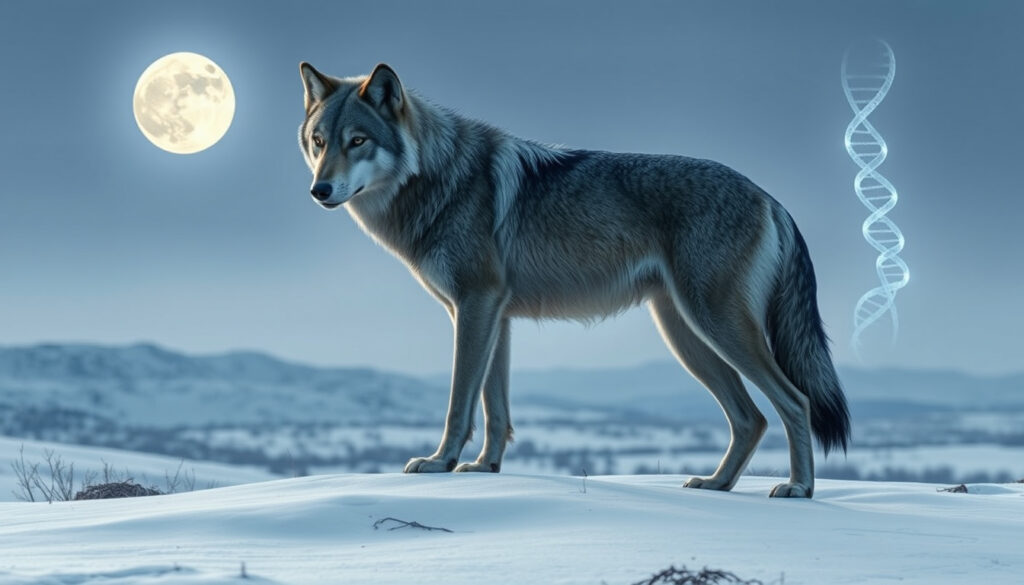
Dire wolf de-extinction: Are they really back? Colossal explained
The idea of a creature that vanished thousands of years ago suddenly walking the Earth again sounds like science fiction. Yet in April 2025, a company called Colossal Biosciences announced the birth of three wolf pups engineered to resemble the long-extinct dire wolf — raising the question of what was actually created and what it means for the future of lost species.
Years extinct: ~13,000 years ·
Engineered pups born: April 2025 ·
Company: Colossal Biosciences ·
Number of pups: 3 ·
Average weight: 110–150 lbs
Quick snapshot
- Colossal created three canids with dire wolf phenotypes using gray wolf genome editing (Wikipedia (community-reviewed encyclopedia))
- 14 key genes were edited to express 20 dire wolf traits (Wikipedia (community-reviewed encyclopedia))
- No ancient dire wolf DNA was used in the process (Wikipedia (community-reviewed encyclopedia))
- Whether the engineered animals behave like original dire wolves (Wikipedia (community-reviewed encyclopedia)) (Colossal Biosciences (leading de-extinction company))
- Ecological impact if ever released into the wild (Colossal Biosciences (leading de-extinction company))
- Long-term viability and reproductive capacity of the pups (Wikipedia (community-reviewed encyclopedia)) (Colossal Biosciences (leading de-extinction company))
- Dire wolves extinct ~13,000 years ago; first engineered pups born October 2024 and January 2025 (Wikipedia (community-reviewed encyclopedia))
- Public announcement of births: April 2025 (Wikipedia (community-reviewed encyclopedia))
- Colossal targets woolly mammoth, thylacine, and dodo de-extinction by 2028 (Colossal Biosciences YouTube (company media channel))
- Giant moa project announced in 2025 (Colossal Biosciences YouTube (company media channel))
Here are the key facts about the dire wolf de-extinction project:
| Label | Value |
|---|---|
| Extinction date | ~13,000 years ago (Late Pleistocene) |
| First engineered pups | April 2025 |
| Number of pups | 3 |
| Lead organization | Colossal Biosciences |
| Average weight (adult) | 110–150 lbs |
| Height at shoulder | ~30 inches |
Did they de-extinct dire wolves?
In short: not exactly. Colossal Biosciences announced in April 2025 the birth of three wolf pups — Romulus, Remus, and Khaleesi — that it calls the first living examples of the dire wolf since the species went extinct roughly 13,000 years ago (Wikipedia (community-reviewed encyclopedia)). But these animals are not true dire wolves in the genetic sense. No ancient dire wolf DNA was spliced into their genome. Instead, Colossal’s scientists edited 14 key genes in the gray wolf genome to express 20 physical traits associated with the extinct predator — white coats, broader skulls, and stockier builds (Wikipedia (community-reviewed encyclopedia)).
What direwolf is still alive? (Fiction vs reality)
- The three pups are genetically modified gray wolves, not clones of an ancient dire wolf (Wikipedia (community-reviewed encyclopedia))
- In May 2025, Colossal’s chief scientist Beth Shapiro stated plainly: the animals are “grey wolves with 20 edits” and it’s impossible to make them identical to the extinct species (Wikipedia (community-reviewed encyclopedia))
- Zoologist Philip Seddon and paleontologist Dr. Nic Rawlence called the animals genetically modified hybrid gray wolves, not true dire wolves (Wikipedia (community-reviewed encyclopedia))
The catch: Colossal’s announcement frames the project as a successful “de-extinction,” while independent scientists see it as impressive genetic engineering — but not resurrection. The distinction matters because it shapes what the public believes is possible and what conservation dollars should fund.
What killed the dire wolf?
Dire wolves (Aenocyon dirus) were a distinct lineage from gray wolves — not a subspecies, but a separate branch entirely (Wikipedia (community-reviewed encyclopedia)). They disappeared around 13,000 years ago at the end of the Pleistocene epoch, alongside many other large Ice Age mammals.
Climate change at the end of the Ice Age
- As the Ice Age ended, warming temperatures altered ecosystems across North America (Wikipedia (community-reviewed encyclopedia))
- Large prey species like mammoths, horses, and bison declined — and dire wolves, built for taking down megaherbivores, suffered (Wikipedia (community-reviewed encyclopedia))
Competition with gray wolves and humans
- Gray wolves (Canis lupus) were more adaptable generalists, able to survive on smaller prey (Wikipedia (community-reviewed encyclopedia))
- Early human hunters may have also intensified pressure on the same prey species (Wikipedia (community-reviewed encyclopedia))
- Fossil evidence from the La Brea Tar Pits shows dire wolves were abundant until their sudden disappearance (Wikipedia (community-reviewed encyclopedia))
What this means: the same environmental pressures that killed off dire wolves — climate change and habitat loss — are accelerating today for existing species. De-extinction projects don’t change that equation.
Was a dire wolf bigger than a great dane?
It depends on the metric. Dire wolves were larger and heavier than modern gray wolves, but not as massive as the largest domestic dog breeds. Here’s how they stack up:
Three predators, one pattern: size tells only part of the story — build and hunting strategy mattered more.
| Feature | Dire Wolf | Gray Wolf | Great Dane |
|---|---|---|---|
| Average weight | 110–150 lbs | 70–120 lbs | 110–175 lbs |
| Height at shoulder | ~30 inches | ~26–34 inches | ~28–34 inches |
| Skull shape | Broader, more robust | Narrower, more streamlined | Long, narrow |
| Build | Stocky, powerful | Lean, athletic | Tall, lanky |
| Bite force (relative) | Stronger per pound | Moderate | Moderate |
- Dire wolves were about 25% heavier on average than gray wolves (Wikipedia (community-reviewed encyclopedia))
- Great Danes match dire wolves in weight but have a much taller, less muscular frame (Wikipedia (community-reviewed encyclopedia))
- Dire wolves’ stockier build reflects their prey — they hunted large, slow-moving Ice Age herbivores (Wikipedia (community-reviewed encyclopedia))
The trade-off: Colossal’s engineered pups will likely reach the size of a large gray wolf, not a full-sized dire wolf — because the edited genes produce phenotypic traits, not the entire ancestral body plan.
When did the dire wolf go extinct?
Dire wolves vanished around 13,000 years ago, near the end of the Pleistocene epoch — roughly 9,000 years before the first gray wolf domestication events (Wikipedia (community-reviewed encyclopedia)). The exact date remains uncertain within a range of several centuries, but the timing correlates strongly with the end of the last Ice Age.
Timeline of extinction events
- ~13,000 years ago: Dire wolves go extinct alongside many other Ice Age mammals (Wikipedia (community-reviewed encyclopedia))
- 2021: Colossal Biosciences founded by Ben Lamm and George Church (Wikipedia (community-reviewed encyclopedia))
- 2023: Colossal announces dire wolf de-extinction project (Wikipedia (community-reviewed encyclopedia))
- October 1, 2024: Two male pups (Romulus and Remus) born (Wikipedia (community-reviewed encyclopedia))
- January 30, 2025: Female pup Khaleesi born (Wikipedia (community-reviewed encyclopedia))
- April 2025: Colossal publicly announces the births (Wikipedia (community-reviewed encyclopedia))
For roughly 13,000 years, the dire wolf existed only as fossilized bones in museum drawers. In the span of 18 months, Colossal turned those bones into a living, breathing animal — even if the animal is technically a gray wolf with a makeover.
The implication: if the timeline holds, Colossal’s model suggests that any species with sufficient DNA preservation — even partial — could be “phenotypically restored” within 2-3 years, provided its closest living relative exists.
What animals are scientists trying to bring back?
Colossal is not stopping at the dire wolf. The company has publicly committed to de-extincting several other iconic species, with timelines stretching into the late 2020s.
- Woolly mammoth: expected milestone around 2028 (Colossal Biosciences YouTube (company media channel))
- Thylacine (Tasmanian tiger): advanced de-extinction work ongoing in 2025 (Colossal Biosciences YouTube (company media channel))
- Dodo: project announced and underway (Colossal Biosciences YouTube (company media channel))
- Giant moa: added in 2025 (Colossal Biosciences YouTube (company media channel))
Conservation groups and regulators face a fundamental question: does a proxy species — one that looks like the original but lacks its full genetic and behavioral heritage — deserve the same ecological role as the original? The IUCN SSC Guiding Principles for de-extinction projects, which Colossal says it follows (Colossal Biosciences (leading de-extinction company)), state that any reintroduced proxy must not harm existing ecosystems. But no one has tested that yet.
For conservationists, the choice is clear: embrace proxy species as a tool for ecological restoration, or insist that de-extinction funds instead go toward protecting existing endangered animals. The dire wolf project makes that debate impossible to ignore.
Confirmed facts
- Dire wolves were a distinct species that went extinct ~13,000 years ago (Wikipedia (community-reviewed encyclopedia))
- Colossal Biosciences created canids that phenotypically resemble dire wolves (Wikipedia (community-reviewed encyclopedia))
- The project used genetic material from ancient dire wolf DNA analysis and gray wolf genome editing (Wikipedia (community-reviewed encyclopedia))
What’s unclear
- Whether the engineered animals are behaviorally similar to original dire wolves (Wikipedia (community-reviewed encyclopedia))
- Ecological impact if released into the wild (Colossal Biosciences (leading de-extinction company))
- Long-term viability and reproductive capacity (Wikipedia (community-reviewed encyclopedia))
“We’ve brought back the dire wolf — the first de-extinction event in history.”
— Ben Lamm, CEO, Colossal Biosciences (Colossal Biosciences (leading de-extinction company))
“They are grey wolves with 20 edits. It’s impossible to make them identical to the extinct species.”
— Dr. Beth Shapiro, Chief Scientist, Colossal Biosciences (Wikipedia (community-reviewed encyclopedia))
“These are not true dire wolves — they are genetically modified hybrid gray wolves. The terminology matters because it sets expectations for what de-extinction can actually deliver.”
— Dr. Nic Rawlence, Paleontologist (Wikipedia (community-reviewed encyclopedia))
For conservationists and the public watching this unfold from across the Atlantic, the stakes are real: de-extinction proxies could change how we think about biodiversity loss, but they also risk diverting attention from the 1 million species currently facing extinction. The dire wolf isn’t back — but our choices about how to respond to its proxy are very much alive.
Frequently asked questions
How many dire wolf pups were born?
Three pups: Romulus and Remus (males, born October 1, 2024) and Khaleesi (female, born January 30, 2025). All three survived beyond infancy as of 2025 (Wikipedia (community-reviewed encyclopedia)).
Are the new dire wolves able to reproduce?
It is currently uncertain. The pups are still young, and their reproductive capacity has not been confirmed. If they are fertile, they could theoretically breed with gray wolves, raising questions about genetic mixing (Wikipedia (community-reviewed encyclopedia)).
Will they be released into the wild?
Colossal has not announced any plan to release the engineered wolves into the wild. The IUCN SSC Guiding Principles require that any proxy species not harm existing ecosystems, and ecological impact studies would be needed first (Colossal Biosciences (leading de-extinction company)).
What is the cost of the de-extinction project?
Colossal has not disclosed exact costs for the dire wolf project specifically, but the company has raised hundreds of millions of dollars in funding and has turned de-extinction into a multibillion-dollar industry (Colossal Biosciences (leading de-extinction company)).
How does this de-extinction differ from cloning a pet?
Cloning requires an intact cell from a living or recently deceased animal. De-extinction uses ancient DNA fragments to guide targeted editing of a related species’ genome — it’s a form of genetic engineering, not cloning (Wikipedia (community-reviewed encyclopedia)).
What is the controversy around de-extinction?
Critics argue that de-extinction is a distraction from conserving living species, that proxy species may not be true ecological replacements, and that the resources could be better spent on habitat protection and anti-poaching efforts (Wikipedia (community-reviewed encyclopedia)).
When might the woolly mammoth be brought back?
Colossal has projected a target around 2028 for the woolly mammoth, though similar technical hurdles exist — the animal will be an elephant with edited genes, not a pure mammoth (Colossal Biosciences YouTube (company media channel)).
More related posts
 Awfully Chocolate Star Vista – Outlet Guide and Menu Details
 TungLok Seafood PLQ: Owner, Menu, Buffet Price & More
 Singapore Work Permit Changes – Age Limits Salary Rules 2025-2026
 Web Design Trends 2025 – AI, 3D and Sustainable Design
 Sentosa Car Entry Fee 2025: Costs, Free Entry & Parking Rates
 Cast of Law and the City: Who Stars in the 2025 K-Drama
 Robert De Niro Movies: Guide to His Best and Latest
 Asian Market Cafe Menu: Prices, Halal Certification & Tips