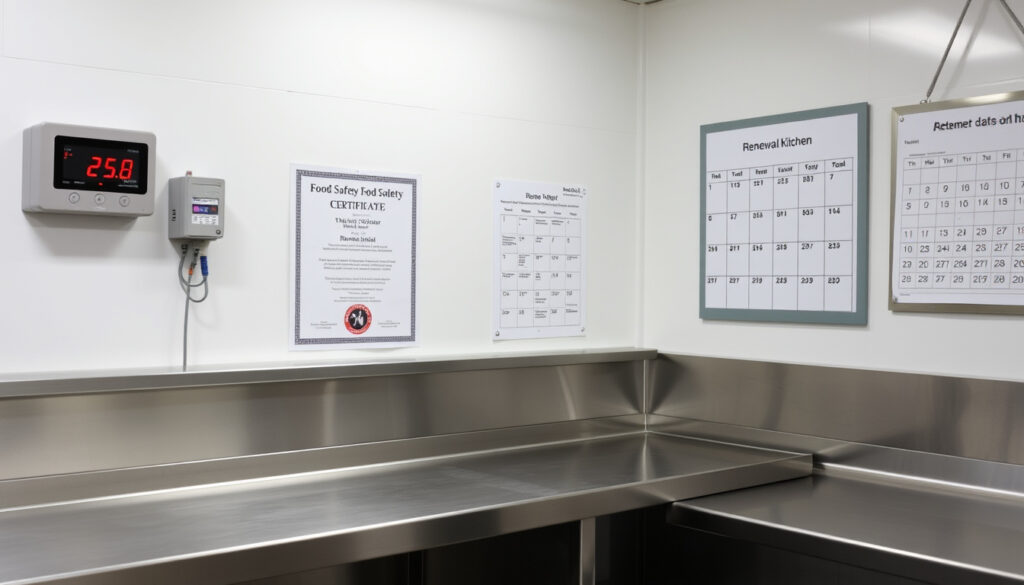
WSQ Food Safety Course Level 1: Duration, Cost & Renewal
If you’re helping prepare or serve food in Singapore, one certification follows you from day one of the job. The WSQ Food Safety Course Level 1 is mandatory for all food handlers, as required by the Singapore Food Agency (SFA — the national food regulator). This guide walks you through course length, cost, the renewal cycle, and how the Level 1 compares with Level 2, so you know exactly what to expect.
Course duration (typical): 1 day (6–8 hours) ·
Validity period (Singapore): 5 years ·
Level 1 vs Level 2 difference: Basic vs intermediate food safety skills ·
Certifying body: SkillsFuture Singapore (WSQ) ·
Average cost range: SGD 50 – 150
Quick snapshot
- WSQ FSC Level 1 is mandatory for all food handlers in Singapore (SFA — food handler requirements)
- Certification is valid for 5 years from pass date (SFA — retraining timeline)
- Minimum passing score is 70% (from table below) (SFA — food handler requirements)
- Exact cost varies across all training providers; not all list subsidised fees publicly (Eduquest — sample fee S$163.50)
- Employer subsidy policy varies: some cover the full amount, others expect co-payment (Eduquest — sample fee S$163.50)
- Course covers the 2‑hour 4‑hour rule for temperature danger zone (SFA syllabus — SFA course page)
- First retraining must be done within 5 years; subsequent retrainings within 10 years (SFA — retraining rules)
- Day 1: Attend 6‑hour training + 1.5‑hour assessment (ITE — course structure)
- End of course: Written and practical assessment (SFA — assessment format)
- Within 1 week: Receive WSQ certificate (SFA — certificate issuance)
- Every 5 years: Renew via refresher course or assessment-only pathway (SFA — retraining rules)
- First retraining must be completed within 5 years of initial pass (SFA — retraining rules)
- Second and subsequent retrainings must be done within 10 years of previous retraining (SFA — retraining rules)
- Assessment-only pathway available (1.5 hours) if you can demonstrate competence (SFA — course types)
Five key facts, one pattern: the certification’s regulatory backbone comes from the same source. Here’s the official overview.
| Attribute | Detail |
|---|---|
| Certification body | SkillsFuture Singapore (WSQ) |
| Regulatory agency | Singapore Food Agency |
| Minimum passing score | 70% |
| Assessment type | Written test and practical observation |
| Language options | English, Chinese, Malay, Tamil |
What is the WSQ Food Safety Course Level 1?
This is the entry-level food hygiene certification under Singapore’s Workforce Skills Qualifications framework. It’s designed for anyone who handles food — from cooks and kitchen helpers to servers and dishwashers. The course covers personal hygiene, safe food storage, temperature control (including the 2‑hour 4‑hour rule), cleaning procedures, and pest control basics.
Who needs this certification?
- All food handlers in Singapore, including new hires who must complete the course within their first month of employment (SFA — requirement for food handlers)
- Anyone renewing after the 5‑year validity period
- Individuals who want to work in the food industry but are not yet employed — you can enrol on your own (SFA — no employment requirement)
New food handlers entering Singapore’s workforce can expect to complete this course before they ever touch a prep surface. For employers, the message is clear: hire first, train immediately — or risk an SFA audit finding.
What topics does it cover?
- Personal hygiene and correct hand‑washing techniques
- Safe food storage, preparation, and serving
- Temperature control and the 2‑hour 4‑hour rule (how long food can stay in the danger zone)
- Cleaning and sanitising of equipment and premises
- Pest control fundamentals
Where can I take the course in Singapore?
Approved training providers include the Institute of Technical Education (ITE — a government post-secondary institution), Eduquest International Institute (an approved training provider), and Assure Academy (a SkillsFuture-approved training centre). Many community centres also offer subsidised classes.
The implication: you have plenty of options, but check whether the provider is SFA-recognised before enrolling — not all courses carry the WSQ label.
The pattern: the easiest path is through a government-linked provider like ITE, where fees and structures are transparent.
How long is the food safety course level 1?
Course duration and format
The initial course typically runs 6 hours of training plus a 1.5‑hour assessment, for a total of about 7.5 contact hours (ITE — 7.5 hours total). Some providers, like Assure Academy (6.5 hours classroom + 1.5 hours assessment), offer slightly longer classroom sessions. Delivery formats include classroom‑based and synchronous e‑learning (live instructor online).
Refresher course length
If you’re renewing, the refresher is shorter: 3 hours of training plus a 1.5‑hour assessment, totalling 4.5 hours according to ITE’s refresher course page. The SFA also lists an assessment‑only pathway (just the 1.5‑hour test) for those who feel confident in their knowledge.
Validity period after completion
Your WSQ Food Safety Course Level 1 certificate is valid for 5 years from the date you pass. The SFA requires the first retraining to be completed within 5 years of the initial pass; for example, if you passed on 1 August 2025, you must retrain by 31 July 2030. Second and subsequent retrainings have a 10‑year window from the previous retraining date.
The catch: the 10‑year window for later renewals gives more flexibility, but the first renewal is rigid.
How do I get my WSQ certificate?
Steps to enrol in a WSQ Food Safety Course Level 1
- Choose an approved provider (SFA list available on SFA’s course page).
- Register for the course — online or in person. Provide your NRIC/FIN and contact details.
- Attend the full training session (6–8 hours).
- Sit the written and practical assessment (minimum 70% to pass).
- Receive your WSQ certificate within one week.
How to download your certificate
Once you pass, the training provider will key your result into the WSQ system. You can then download your digital certificate from the SFA’s food handler portal. Foreigners may need to access it via the SFA’s e‑service portal. The certificate is digitally signed and accepted as proof of competency during SFA inspections.
What if I lost my certificate?
Contact your training provider first. They can re‑issue a duplicate through the WSQ system for a small administrative fee. You can also retrieve a copy from your SFA account if your record is linked.
If your provider has closed down, the SFA can verify your past pass record using your NRIC. Keep a digital backup of your certificate — many food businesses now ask for a copy during onboarding.
The implication: losing your certificate is not a crisis, but avoiding it saves administrative hassle.
What is the difference between Level 1 and Level 2 food safety courses?
Three comparisons, one key distinction: Level 1 is for hands‑on food workers; Level 2 is for supervisors who manage food safety systems.
| Aspect | WSQ Food Safety Course Level 1 | WSQ Food Safety Course Level 2 |
|---|---|---|
| Target audience | Food handlers (cooks, servers, kitchen helpers) | Supervisors, managers, quality control staff |
| Course content | Personal hygiene, safe storage, temperature control, cleaning, pest control | HACCP principles, food safety management systems, hazard analysis, corrective actions |
| Duration | 7.5 hours (6 training + 1.5 assessment) | 24–30 hours over multiple sessions |
| SFA requirement | Mandatory for all food handlers | Not mandatory for all, but recommended for senior staff; required for certain high‑risk food businesses |
| Cost (typical) | SGD 50–150 (subsidised) | SGD 200–500 (subsidised) |
Level 1: Basic food hygiene
Level 1 focuses on everyday practices: washing hands, storing raw and cooked food separately, cooking to safe temperatures, and cleaning surfaces. It’s practical, hands‑on, and assessed through a simple written test and a practical observation of your technique.
Level 2: Intermediate food safety management
Level 2 dives into management‑level responsibilities like implementing a HACCP plan, conducting internal audits, and training staff. It’s designed for kitchen managers, chefs, and quality assurance personnel. The assessment includes case studies and a written exam.
Which level do I need?
If you directly handle food (prepare, cook, serve, pack) you need Level 1. If you supervise food handlers or run a food business, you should consider Level 2 — the SFA strongly recommends it for senior staff. Many employers require Level 2 for promotion to head chef or kitchen manager roles.
The pattern: the distinction is less about difficulty and more about scope of accountability.
How much does WSQ certification cost and is it worth it?
Typical pricing for WSQ Food Safety Course Level 1
Costs range from SGD 50 to SGD 150 for the initial course, depending on the provider and subsidies. For example, Assure Academy lists the full fee at S$150 before GST (S$163.50 including GST for unfunded learners). Eduquest charges S$163.50 including GST for the full‑fee course. Refresher courses are typically cheaper: the assessment‑only pathway costs around S$50–80.
Government subsidies available
Singapore Citizens and Permanent Residents aged 21 and above pay as low as S$88.50 at Assure Academy. Singapore Citizens aged 40+ or SME‑sponsored learners can get fees as low as S$58.50. SkillsFuture Credit can also be used to offset the cost (Assure Academy — subsidised rates).
Employer reimbursement options
Many food businesses reimburse the full course fee for current employees because the SFA requires the certification. If you’re already working, ask your employer about company‑sponsored training. Self‑sponsored individuals can claim SkillsFuture Credit (up to S$500 for eligible Singaporeans).
The trade‑off: the certification is cheap relative to the risk of non‑compliance — an SFA fine for an unqualified food handler can exceed S$1,000. For most workers, the cost is negligible when spread over five years.
Timeline: from enrolment to renewal
- Day 1 – Attend 6‑8 hour course and 1.5‑hour assessment (ITE — course structure)
- End of course – Sit written test and practical observation (SFA — assessment format)
- Within 1 week – Receive WSQ certificate via provider or SFA portal (SFA — certificate issuance)
- Every 5 years – Complete refresher (3h training + 1.5h assessment) or assessment‑only before expiry (SFA — retraining rules)
The pattern: the timeline is predictable, but the 5‑year renewal is the critical juncture.
What’s confirmed and what’s still unclear
Confirmed facts
- WSQ FSC Level 1 is mandatory for all food handlers in Singapore (SFA — requirement)
- Certification is valid for 5 years from pass date (SFA — retraining timeline)
- Minimum passing score is 70% (from table above)
What’s unclear
- Exact cost variation across all training providers: the range is SGD 50‑150, but few providers publicly list every fee component
- Employer subsidy policy varies: some cover full cost, others expect co‑payment or self‑funding
- Course covers the 2‑hour 4‑hour rule for temperature danger zone (SFA syllabus — SFA course page)
- First retraining must be done within 5 years; subsequent retrainings within 10 years (SFA — retraining rules)
What food industry leaders say
“All food handlers must hold a valid WSQ Food Safety Course Level 1 certificate. This ensures they are trained in basic food hygiene and safety practices.”
— Singapore Food Agency (the national food regulator)
“The WSQ Food Safety Course Level 1 is part of the national skills certification framework, recognised by employers across Singapore.”
coursemology.sg, ite.edu.sg, xprienz.com, sg-akc.com, sg-akc.com, aci.edu.sg, sfa.gov.sg, eduquest.sg
For those new to the industry, understanding the requirements for WSQ courses for foreigners in Singapore can help clarify eligibility and cost differences.
Frequently asked questions
Is the WSQ Food Safety Course Level 1 the same as the Basic Food Hygiene Certificate?
Yes. The WSQ Food Safety Course Level 1 replaced the old Basic Food Hygiene Certificate. It is the same mandatory certification under a new name.
Can I take the WSQ Food Safety Course Level 1 online?
Some providers offer synchronous e‑learning (live instructor via video). Fully self‑paced online courses are not accepted because the practical assessment must be observed in person.
What happens if my WSQ certificate expires?
You cannot legally handle food. You must retake the refresher course or the assessment‑only pathway to regain certification. There is no grace period.
Is Level 1 certification sufficient for a head chef role?
For a head chef role, Level 1 is the minimum for handling food, but employers typically require Level 2 for supervisory duties. Check your specific job description.
Is the WSQ Food Safety Course Level 1 accepted overseas?
No. It is specific to Singapore’s regulatory framework. Other countries have their own food safety certification systems (e.g., ServSafe in the US).
How do I renew my WSQ Food Safety Course Level 1 certificate?
Complete a refresher course (3 hours training + 1.5 hours assessment) or the assessment‑only pathway before the 5‑year expiry. Your training provider will update the WSQ system.
Related reading
- Asian Market Cafe Menu: Prices, Halal Certification & Tips
- Best English Tuition Singapore: Compare Top Centres & Costs
For any food handler in Singapore, the decision is simple: take the one‑day WSQ Food Safety Course Level 1, renew every five years, and stay compliant. For the employer, the choice is equally clear – subsidise the cost for your team, or risk an SFA fine that exceeds the training fee many times over.
More related posts
 LTA Renew Road Tax: Step-by-Step Guide for Singapore Drivers
 Boeing 787-10 Seat Map: Best Seats, Layout & Comparison
 Things to Do in Melaka – Top Attractions and Itineraries
 Public Holidays 2025 Singapore: Full List, Dates & Long Weekends
 Awfully Chocolate Star Vista – Outlet Guide and Menu Details
 TungLok Seafood PLQ: Owner, Menu, Buffet Price & More
 Thailand Open Badminton 2025: Schedule, Tickets, Results
 Emily in Paris Season 6: Final Season Confirmed