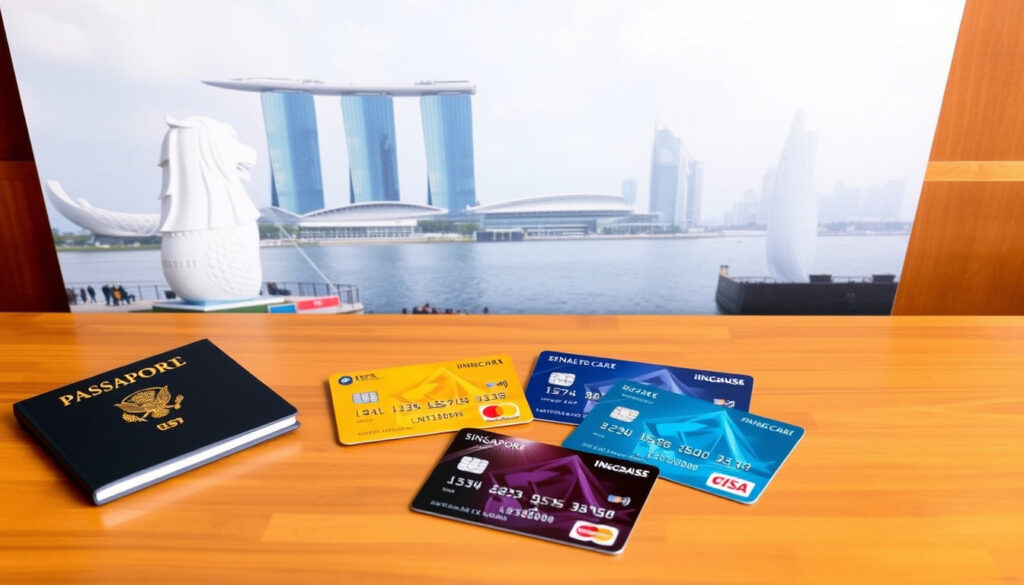
Best Travel Credit Card Singapore: Top Picks Compared
Choosing a travel credit card in Singapore can feel like a puzzle — miles, fees, lounge access, and foreign transaction charges all compete for attention. The right card depends on how you spend and where you’re headed — here’s a side-by-side comparison using real earn rates and fee data.
Average miles per dollar on overseas spend: 2.2 mpd ·
Typical foreign transaction fee: 3.25% ·
Number of travel credit cards in Singapore: over 20 ·
Annual fee range for top cards: S$0 to S$321 ·
Minimum income requirement: S$30,000 to S$120,000
Quick snapshot
- Citi PremierMiles earns 1.2 mpd locally and 2.2 mpd overseas (YouTrip comparison hub)
- UOB PRVI Miles earns 1.4 mpd locally and 2.4 mpd overseas (YouTrip comparison hub)
- Exact miles expiry for DBS Travel Credit Card may vary by promotion
- Whether the 2/3/4 rule applies uniformly across all banks is not publicly documented
- HSBC Revolution may have a permanently free annual fee, but terms could change (YouTrip comparison hub)
- HSBC TravelOne offers 4 complimentary lounge visits per year, but availability may depend on account status (YouTrip comparison hub)
- No timeline data provided — cards compared as of 2026 offerings
- Banks may revise earn rates and fees; check current terms before applying
Five key specs, one pattern: all the top travel cards earn more overseas than at home, but the best pick depends on how you value miles expiry, lounge access, and annual fees.
| Card | Local earn rate | Overseas earn rate | Annual fee | Lounge visits | Miles expiry |
|---|---|---|---|---|---|
| Citi PremierMiles | 1.2 mpd | 2.2 mpd | S$196.20 (10,000 renewal miles) | 2 per year | Never expire |
| UOB PRVI Miles | 1.4 mpd | 2.4 mpd | S$256.80 | With min. spend | 2 years |
| HSBC TravelOne | 1.2 mpd | 2.4 mpd | S$196.20 (waived at S$25,000 spend) | 4 per year (shareable) | 2 years |
| HSBC Revolution | 1.2 mpd (up to 4 mpd on online/contactless) | 2.5 mpd on foreign transactions | Free | 4 per year | 2 years |
The takeaway: Citi PremierMiles suits long-term mile hoarders, while HSBC TravelOne offers the most lounge flexibility. UOB PRVI Miles leads in raw overseas earn rate, but charges the highest annual fee.
What is the best travel credit card in Singapore?
There is no universal winner — the best travel card depends on whether you prioritise miles for flights, cashback on foreign spend, or lounge access, as Aspire (financial comparison platform) points out.
Citi PremierMiles Card
- Earns 1.2 mpd locally and 2.2 mpd overseas (YouTrip comparison hub)
- Annual fee S$196.20, no spend waiver, but offers 10,000 renewal miles (YouTrip comparison hub)
- Miles never expire — a rare perk for Singapore cards
UOB PRVI Miles Card
- Earns 1.4 mpd locally and 2.4 mpd overseas (YouTrip comparison hub)
- Miles expire after 2 years
- Annual fee S$256.80
HSBC TravelOne Card
- Earns 1.2 mpd locally and 2.4 mpd overseas (YouTrip comparison hub)
- Annual fee S$196.20, waived if annual spend reaches S$25,000 (YouTrip comparison hub)
- Offers 4 complimentary lounge visits per year that can be shared (YouTrip comparison hub)
HSBC Revolution Card
- Earns up to 4 mpd on eligible online and contactless spending (YouTrip comparison hub)
- Annual fee permanently free (YouTrip comparison hub)
- Includes 4 lounge visits per year according to SingSaver (comparison site)
Mile hoarders who rarely want to think about deadlines will find Citi PremierMiles compelling. But for most travellers, the annual fee waiver and lounge count make HSBC TravelOne the more practical everyday companion.
The pattern: No single card dominates all categories; the choice depends on how you spend and travel.
Does Singapore have a travel card?
Yes — Singapore has multiple travel credit cards issued by local banks such as DBS, UOB, OCBC, HSBC, and Citibank. For Australians visiting, the Singapore dollar travel card is often a prepaid multi-currency card like Wise, not a credit card. Another popular option is the Revolut card, which can be used in Singapore for spending in SGD with no foreign transaction fees on weekdays.
Revolut card in Singapore
- No foreign transaction fees on weekday spending in SGD
- Offers interbank exchange rates
The pattern: traditional travel credit cards earn miles but often charge a foreign transaction fee (typically 3.25%), while prepaid multi-currency accounts save on fees but earn no rewards. The trade-off is mileage rewards vs. zero-commission spending.
Is it better to take cash or card to Singapore?
Singapore is highly cashless — credit cards are accepted at hotels, restaurants, and major retailers. However, cash is still needed at hawker centres, taxis, and small merchants. For larger purchases, using a travel credit card with no foreign transaction fee is generally better than cash, because you earn miles and avoid holding large amounts of foreign currency.
The transaction fee for most Singapore credit cards on overseas spend is 3.25% (YouTrip comparison hub). Cards like HSBC TravelOne and Citi PremierMiles charge 0% foreign transaction fee, making them ideal for card spending abroad.
Which credit card is good for public transport in Singapore?
Public transport in Singapore — MRT and buses — is increasingly contactless via SimplyGo. Cards like DBS Live Fresh, OCBC Frank, and UOB One offer cashback or rebates on transport spending. The best card for public transport typically has no annual fee and offers at least 1% cashback on transport, as noted by SingSaver (comparison site).
- DBS Live Fresh: up to 1% cashback on public transport
- UOB One: rebates on MRT and bus spend when minimum conditions met
- SimplyGo integration: tap your contactless credit card directly at fare gates
If you commute daily, a no-fee cashback card nets you S$30–S$50 per year in transport rebates — small, but better than earning 0.3 miles per dollar on a miles card that will expire unused.
What this means: For public transport, prioritise cashback cards over miles cards to avoid wasted miles.
How do I avoid 3% foreign transaction fee?
Several travel credit cards in Singapore charge 0% foreign transaction fee on overseas spend. According to YouTrip’s comparison, cards like Citi PremierMiles, UOB PRVI Miles, and HSBC TravelOne have no foreign transaction fee. Alternatively, multi-currency accounts such as Revolut, Wise, and YouTrip allow spending at interbank rates with no fee on weekdays. For more on exchange rates, see our guide on OCBC Foreign Exchange Rate.
Using a multi-currency account saves 3.25% per transaction but forgoes miles. On a S$10,000 holiday, that’s S$325 saved in fees — enough to buy a short-haul flight. Mile earners need a miles card with no fee to get both benefits.
The catch: The best approach mixes a no-fee miles card for large overseas purchases with a multi-currency account for smaller everyday spending.
What is the 2/3/4 rule?
The 2/3/4 rule refers to credit card application limits used by some Singapore banks: you can have at most 2 cards applied for in 6 months, 3 in 12 months, and 4 in 24 months. Applying too often can hurt your credit score. Learn how to manage payments with our guide on How to Pay Credit Card Bill.
Upsides
- No foreign transaction fee on Citi PremierMiles, UOB PRVI Miles, HSBC TravelOne
- Miles accumulate on overseas spend (2.2–2.4 mpd)
- Lounge access included on premium cards
Downsides
- Annual fees range from S$0 to S$256.80
- Miles expiry (1–2 years) on most cards
- Minimum income requirements up to S$120,000
“The best travel credit card for me turned out to be the HSBC TravelOne — the lounge access alone is worth the annual fee, and I never worry about foreign transaction fees.”
— Reddit user on r/singaporefi
“HSBC TravelOne offers instant redemptions with airline and hotel partners via the mobile app — no more waiting weeks for miles to post.”
— HSBC Singapore product page
“When comparing travel cards, look beyond the headline earn rate. Check the foreign transaction fee, annual fee waiver conditions, and whether miles expire.”
— MoneySmart editorial team
For travellers who spend mostly overseas, the choice is clear: pick a card with 0% foreign transaction fee and the highest overseas earn rate. For daily commuters, a no-fee cashback card integrated with SimplyGo wins. For Singapore-based flyers who visit lounges, HSBC TravelOne offers the best lounge value at S$196.20 per year waivable at S$25,000 spend.
For those weighing their options, the Standard Chartered Journey credit card offers a strong balance of miles and flexible benefits.
Frequently asked questions
What is the best travel credit card for miles in Singapore?
Citi PremierMiles for never-expiring miles, UOB PRVI Miles for highest overseas earn rate (2.4 mpd), and HSBC TravelOne for lounge access.
Can I use my Singapore credit card overseas without extra fees?
Yes — cards like Citi PremierMiles, UOB PRVI Miles, and HSBC TravelOne charge 0% foreign transaction fee.
Which credit card gives the most miles for flight bookings?
UOB PRVI Miles earns 2.4 mpd overseas, which includes flights booked abroad. For online flight bookings in SGD, HSBC Revolution earns 4 mpd on eligible online spend.
Is the HSBC TravelOne card worth it?
Yes if you value lounge access — 4 visits per year shareable. The annual fee is S$196.20 but waived at S$25,000 annual spend.
How do I apply for a travel credit card in Singapore?
Applications can be submitted online via bank websites. Required documents typically include NRIC, latest income statement, and proof of address. Minimum income ranges from S$30,000 to S$120,000.
What is the minimum income for a travel credit card in Singapore?
S$30,000 for most miles cards; S$120,000 for premium cards like Citi PremierMiles.
Do travel credit cards in Singapore offer lounge access?
Yes — HSBC TravelOne offers 4 visits, Citi PremierMiles offers 2, UOB PRVI offers access with minimum spend.
More related posts
 Monarch: Legacy of Monsters: Guide, Cast & Reception
 Singapore MRT Line Map: PDF Download, 2026 Plans & Apps
 Build A Bear Singapore – No Stores, Nearest KL Guide
 Tokyo Weather in May: Temperature, Rain & Packing
 Sentosa Car Entry Fee 2025: Costs, Free Entry & Parking Rates
 Buy a Black Dress Online in Ireland: Best Stores 2025
 Boeing 737-800 Safety: Crash History, Features, and Seat Guide
 Web Design Trends 2025 – AI, 3D and Sustainable Design