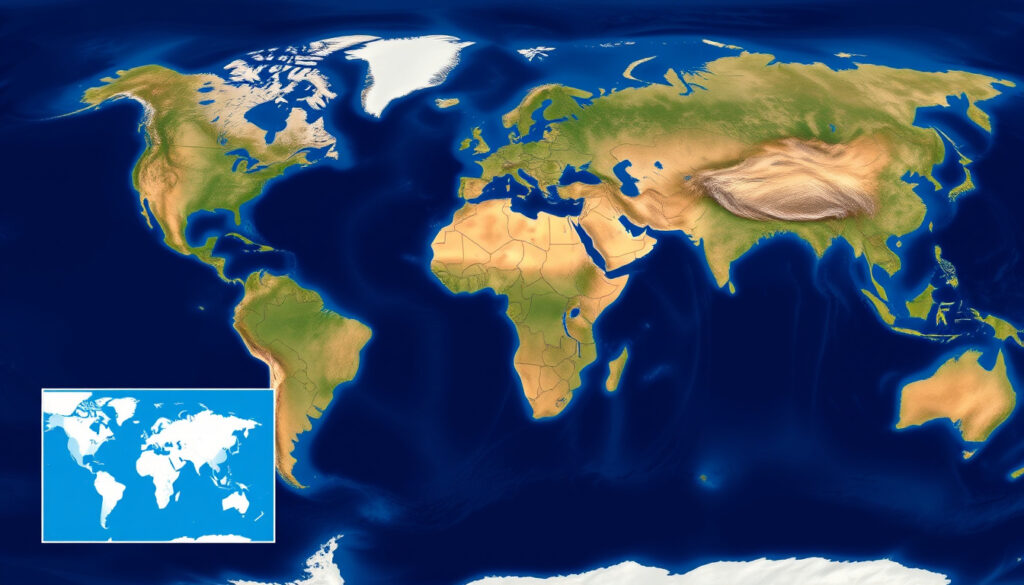
How Many Oceans in the World? 5 vs 7 Explained by NOAA
You might remember learning that there are five oceans, but lately you’ve probably heard people mention seven. The confusion isn’t your fault — it’s the result of how science, history, and culture each draw the lines differently. This article explains the official count, why some traditions say seven, and what that means for maps, classrooms, and the Southern Ocean’s recent addition.
Oceans on Earth: 5 (officially recognized by NOAA) ·
Global ocean coverage: 71% of Earth’s surface ·
Most recent ocean recognized: Southern Ocean (2000) ·
Largest ocean: Pacific Ocean ·
Smallest ocean: Arctic Ocean
Quick snapshot
- NOAA recognizes 5 oceans: Atlantic, Pacific, Indian, Arctic, Southern (NOAA National Ocean Service)
- One global ocean covers 71% of Earth (NOAA National Ocean Service)
- Southern Ocean officially proposed in 2000 (NOAA National Ocean Service)
- Southern Ocean boundaries not yet ratified by all IHO members (NOAA National Ocean Service)
- Some educational systems still teach the 7‑ocean model (Geography Realm)
- Historical “seven seas” concept varies by culture (Geography Realm)
- 1950s: IHO defines 4 oceans (Atlantic, Pacific, Indian, Arctic) (Geography Realm)
- 2000: IHO proposes Southern Ocean as 5th (NOAA National Ocean Service)
- 2021: National Geographic updates maps to include Southern Ocean (Discovery)
- IHO ratification pending for Southern Ocean boundaries (NOAA National Ocean Service)
- More countries expected to adopt 5‑ocean model in curricula (World Population Review)
- Climate research focusing on Southern Ocean’s role in global currents (NOAA National Ocean Service)
The table below compiles official ocean statistics from NOAA and other sources.
| Attribute | Data |
|---|---|
| Number of recognized oceans | 5 (NOAA National Ocean Service) |
| Global ocean coverage | 71% of Earth’s surface (NOAA National Ocean Service) |
| Year Southern Ocean recognized | 2000 (proposed) (NOAA National Ocean Service) |
| Smallest ocean | Arctic Ocean (Discovery) |
| Southern Ocean boundaries | From Antarctica to 60°S (NOAA National Ocean Service) |
| Traditional 4 oceans | Atlantic, Pacific, Indian, Arctic (NOAA National Ocean Service) |
How many oceans are there in the world?
The official answer from the U.S. National Oceanic and Atmospheric Administration is clear: there is one global ocean that covers 71% of Earth, and that single body is geographically divided into five named regions. But depending on where you learned geography, you may have heard a different number.
What are the five officially recognized oceans?
- Pacific Ocean – the largest and deepest, covering roughly 63.8 million square miles (NOAA National Ocean Service)
- Atlantic Ocean – second largest, about 41.1 million sq mi
- Indian Ocean – third largest, about 27.2 million sq mi
- Southern Ocean – fourth largest, about 7.8 million sq mi, recognized by the U.S. Board on Geographic Names as the waters from Antarctica to 60°S (NOAA National Ocean Service)
- Arctic Ocean – smallest, about 5.4 million sq mi (Discovery)
The size order is consistent across major sources, though exact area figures vary slightly. NOAA treats these five as the globally accepted set.
Why do some people say there are seven oceans?
- The “seven oceans” concept has historical roots, often referring to the Atlantic, Pacific, Indian, Arctic, and then splitting the Atlantic and Pacific into North and South halves (Geography Realm)
- Some older cultural or literary traditions include the Mediterranean, Caribbean, or other seas as separate oceans
- No modern scientific body recognizes a seven‑ocean model; it remains a historical classification (World Population Review)
The pattern: Scientific authorities favor five, but cultural traditions keep the seven-ocean concept alive.
Are there 5 or 7 oceans in the world?
The question often comes down to whether you count the Southern Ocean separately and whether you split the Atlantic and Pacific into northern and southern basins. Below is a direct comparison.
Two models, one key difference: the role of the Southern Ocean and historical splitting.
| Aspect | 5‑Ocean Model | 7‑Ocean Model |
|---|---|---|
| Number of oceans | 5 | 7 |
| Included regions | Atlantic, Pacific, Indian, Arctic, Southern | North Atlantic, South Atlantic, North Pacific, South Pacific, Indian, Arctic, Southern |
| Recognition status | Adopted by NOAA, U.S. Board on Geographic Names, National Geographic (since 2021) | Historical/ cultural, not used by modern oceanographic agencies |
| Teaching in schools | Most U.S. curricula now teach 5 oceans (NOAA National Ocean Service) | Still found in some older textbooks and non‑Western systems |
The pattern: The 5‑ocean model is the official scientific standard; the 7‑ocean model is a relic of pre‑modern cartography. Choosing one over the other is less about right vs. wrong and more about whether you follow modern oceanography or historical convention.
What is the difference between the 5‑ocean and 7‑ocean models?
- The 5‑ocean model treats the Southern Ocean as a distinct region; the 7‑ocean model often excludes it or merges it into the Pacific and Atlantic
- The 7‑ocean model splits the Atlantic and Pacific into north and south basins, which NOAA does not do
- The Southern Ocean’s recognition in 2000 is what moved the count from 4 to 5 for most authorities (NOAA National Ocean Service)
Which model is taught in schools?
- In the United States, the National Geographic Society updated its maps in 2021 to include the Southern Ocean (Discovery), so most U.S. schools now teach five oceans
- Many other countries follow the International Hydrographic Organization’s (IHO) pending ratification, but the trend is toward five
The takeaway: Modern geography education increasingly adopts the five-ocean model.
Is it 7 seas or 7 oceans?
The phrase “seven seas” has ancient origins, appearing in Sumerian and Persian texts, and later in European literature. It does not refer to the same thing as the modern “seven oceans” concept.
What are the 7 seas historically?
- The “seven seas” list varies across cultures; a common medieval European list included the Mediterranean, Adriatic, Black Sea, Red Sea, Arabian Sea, Persian Gulf, and Caspian Sea
- These were all bodies of water important for trade and exploration, not open oceans
- Today the phrase is used poetically, not scientifically (Geography Realm)
How do the 7 seas differ from the 7 oceans?
- The 7 seas are mostly inland or marginal seas; the 7 oceans refer to major ocean basins
- Both concepts are informal and variable — there is no official body that defines either
- Modern oceanography uses the five‑ocean model, not “seas” as a count
The key distinction: ‘Seven seas’ is a poetic term, not a scientific classification.
Which ocean is the cleanest, warmest, and deadliest?
Different oceans hold extreme records, and each has its own character that affects marine life, climate, and human activity.
Which is the cleanest ocean?
- The Southern Ocean is widely considered the cleanest, thanks to low human population around Antarctica and minimal industrial pollution (NOAA National Ocean Service)
- Its cold, isolated waters have less plastic debris and nutrient runoff
Which is the warmest ocean?
- The Indian Ocean has the highest average surface temperature at about 27°C (80.6°F) (World Population Review)
- Its tropical location and limited mixing with colder waters keep it warm year‑round
Which is the deadliest ocean?
- The Pacific Ocean is considered the most hazardous due to the Ring of Fire (volcanic and seismic activity) and the highest number of tropical cyclones (Geography Realm)
- It also includes the Mariana Trench, the deepest point on Earth (11,034 m), but “deadliest” refers to natural hazards, not depth
These extremes highlight the diversity of the world’s oceans.
What are the five oceans in order of size?
From largest to smallest, the five oceans cover vastly different areas.
| Rank | Ocean | Approximate area (million sq mi) |
|---|---|---|
| 1 | Pacific | 63.8 |
| 2 | Atlantic | 41.1 |
| 3 | Indian | 27.2 |
| 4 | Southern | 7.8 |
| 5 | Arctic | 5.4 |
Data based on NOAA and Discovery sources.
What is the largest ocean?
- The Pacific Ocean covers more area than all landmasses combined (NOAA National Ocean Service)
What is the smallest ocean?
- The Arctic Ocean is the smallest at 5.4 million sq mi (Discovery)
How do the oceans rank by area?
- Pacific (largest) → Atlantic → Indian → Southern → Arctic (smallest)
The size ranking reinforces the dominance of the Pacific Ocean.
Timeline of ocean recognition
How the world’s oceans were officially named and reclassified over time.
- 1950s: International Hydrographic Organization (IHO) defines four oceans: Atlantic, Pacific, Indian, Arctic (Geography Realm)
- 1999: U.S. Board on Geographic Names approves the name “Southern Ocean” for waters around Antarctica (Discovery)
- 2000: IHO proposes the Southern Ocean boundaries (not yet ratified) (NOAA National Ocean Service)
- 2021: National Geographic Society formally adds the Southern Ocean to its world map (Discovery)
The pattern: Each step reflects a shift from historical convenience to scientific precision, driven by oceanographic research and climate understanding.
What we know and what remains uncertain
Confirmed facts
- NOAA recognizes 5 named oceans (NOAA National Ocean Service)
- The global ocean covers 71% of Earth’s surface (NOAA National Ocean Service)
- The Southern Ocean was proposed as the fifth in 2000 (NOAA National Ocean Service)
- National Geographic updated its maps in 2021 (Discovery)
What’s unclear
- Southern Ocean boundaries have not been ratified by all IHO members (NOAA National Ocean Service)
- Whether the 7‑ocean model is still taught in some regions (World Population Review)
- Exact historical definitions of “seven seas” vary by culture (Geography Realm)
These uncertainties reflect ongoing scientific and educational evolution.
Expert perspectives
“While there is only one global ocean, the vast body of water that covers 71 percent of Earth is geographically divided into distinct named regions.”
— NOAA National Ocean Service (NOAA National Ocean Service)
“The designation of the world’s oceans has evolved over time based on historical, geographic, and cultural factors.”
— Geography Realm (Geography Realm)
These expert views bridge the gap between scientific and public understanding.
Summary
The five‑ocean model — Atlantic, Pacific, Indian, Arctic, and Southern — is the modern scientific standard adopted by NOAA, the U.S. Board on Geographic Names, and mapmakers like National Geographic. The older seven‑ocean concept, while still popular in cultural references, has no official standing. For students, travelers, and geography enthusiasts, the key takeaway is that the number depends on whose framework you use — but if you’re looking for the answer that appears on today’s official maps, it’s five. For educators updating curricula, the shift toward five is nearly complete, and the Southern Ocean’s role in climate science makes its inclusion more urgent than ever. For travel enthusiasts, consider that the routes across these oceans vary — for example, the London to Singapore flight time crosses the Atlantic and Indian Oceans, highlighting the practical relevance of ocean boundaries.
The National Oceanic and Atmospheric Administration recognizes five oceans, and the five oceans explained provides a thorough explanation.
Frequently asked questions
What is the deepest point in the ocean?
The Mariana Trench in the Pacific Ocean reaches about 11,034 meters (36,201 feet) deep — the deepest known point on Earth (NOAA National Ocean Service).
Which ocean is the most biologically productive?
The Southern Ocean supports massive phytoplankton blooms and is highly productive, especially around Antarctica (NOAA National Ocean Service).
How does the Southern Ocean affect global climate?
It drives the Antarctic Circumpolar Current, which regulates heat exchange and helps distribute nutrients worldwide (Discovery).
What is the average salinity of ocean water?
The global average salinity is about 35 parts per thousand, but it varies from 30 to 40 ppt depending on evaporation and freshwater input (NOAA National Ocean Service).
Which ocean has the most islands?
The Pacific Ocean contains the most islands, including the vast archipelagos of Polynesia, Micronesia, and Melanesia (Geography Realm).
What is the difference between an ocean and a sea?
Seas are smaller, partly enclosed bodies of water that are often connected to an ocean. For example, the Mediterranean Sea is a sea of the Atlantic Ocean. For those interested in marine attractions, check the Sea Aquarium opening hours in Singapore.
How many seas are there in the world?
There is no official count, but there are dozens of recognized seas. The number varies depending on the definition and whether marginal seas are included.
What are the 7 continents and 5 oceans names?
7 continents: Africa, Antarctica, Asia, Europe, North America, Australia (Oceania), South America. 5 oceans: Atlantic, Pacific, Indian, Arctic, Southern.
The FAQ addresses common curiosities about ocean geography.
More related posts
 Tan Tong Meng Tower: History, Haunting & Property Details
 Macclesfield vs Crystal Palace Lineups: FA Cup Shock 2026
 Awfully Chocolate Star Vista – Outlet Guide and Menu Details
 10k USD to SGD: Exchange Rates, Salary & Retirement Guide
 Boeing 737-800 Safety: Crash History, Features, and Seat Guide
 Lion-Phillip S-REIT ETF: Yield, Holdings, and 2026 Outlook
 Mount Elizabeth Novena Hospital Photos: Rooms, ICU & Facilities
 Sindo Ferry Schedule 2025: Routes from HarbourFront & Tanah Merah