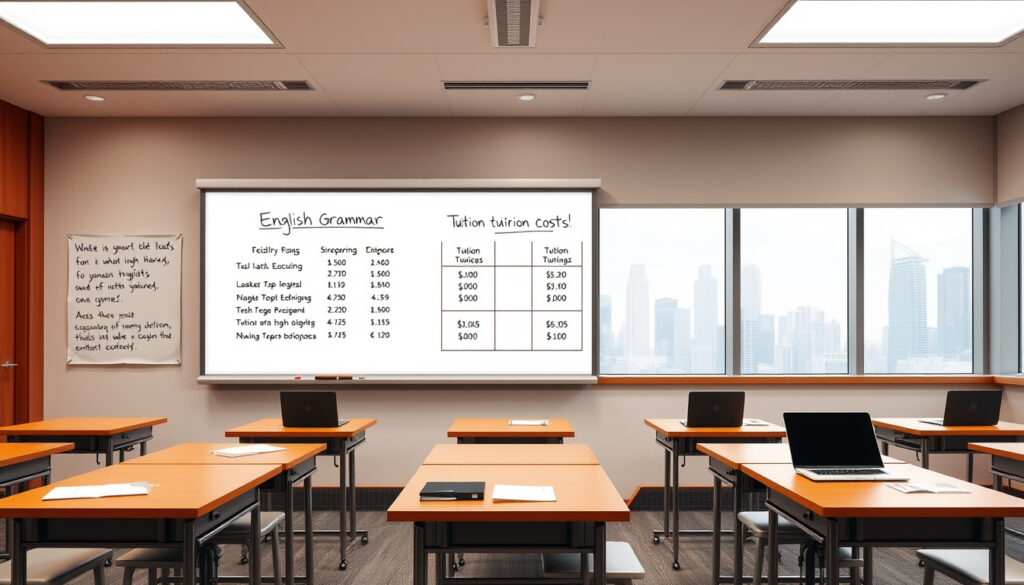
Best English Tuition Singapore: Compare Top Centres & Costs
Every parent in Singapore faces the same puzzle: which English tuition will actually give their child an edge? With dozens of centres, agencies, and private tutors competing for attention, the choice can feel overwhelming. This guide cuts through the noise with concrete facts, real pricing, and a clear look at what works—from established names like Creative Campus (25+ years in the market) to newer online platforms offering flexible schedules.
English tuition centres listed in Singapore: 30+ (from search results) ·
Centers with over 25 years experience: e.g., Creative Campus ·
Students scoring AL1 at top centers: 80% (AL1 Academy claim)
Quick snapshot
- English is one of Singapore’s four official languages (Wikipedia – language policy overview)
- PSLE English tuition costs range from ~S$200 to S$500+ per month for group classes (Skoolopedia – parent guide)
- Top centres like Creative Campus have operated for over 25 years (Creative Campus – official site)
- The exact best tuition centre depends heavily on the child’s specific needs and learning style (SmileTutor – platform comparison)
- Effectiveness of online tuition vs in-person classes varies by provider and student (SmileTutor – platform comparison)
- Average monthly cost is hard to pin down due to wide variation from S$200 to over S$2,000 (Tutor City – spending data)
- Some agencies claim tutor placements within 24 hours (SmileTutor – rapid matching)
- Tuition centres typically follow MOE school terms with intensive PSLE workshops in Primary 6 (SmileTutor – rapid matching)
- Enrolment spikes ahead of the PSLE exam cycle (September–October) (SmileTutor – rapid matching)
- Demand for English teachers in Singapore continues to grow (Wikipedia – education landscape)
- Online tuition platforms are expanding with live and recorded options (Wikipedia – education landscape)
- PSLE preparation will intensify as parents seek proven results (Wikipedia – education landscape)
| Fact | Details |
|---|---|
| Number of English tuition options in Singapore | 30+ (from Singapore Tuition Teachers – directory) |
| Top centre student performance | 80% AL1 at AL1 Academy (Sassy Mama – education roundup) |
| Years of experience of leading centres | Over 25 years (Creative Campus) |
Which is the best home tuition agency in Singapore?
Criteria for choosing a home tuition agency
- Look for agencies that verify tutor qualifications and offer trial lessons.
- Match based on syllabus (MOE, international) and location.
- Check for transparent pricing and refund policies.
Top home tuition agencies in Singapore (from search results)
According to SmileTutor (tuition placement agency), MindFlex is the #1 established agency with a large database of tutors. Others include SmileTutor itself, which claims placements within 24 hours.
How to verify tutor qualifications
- Ask for MOE teaching experience or relevant degrees.
- Request references and trial sessions.
- Check if the agency conducts background screenings.
Which online tuition is best in Singapore?
Best online tuition platforms (from ‘Find Your Perfect Online Tutor’ list)
- Online platforms like SmileTutor (online booking system) offer both live and recorded lessons.
- Some centres provide free trial classes to test the format.
Comparison of features: live vs recorded, pricing
- Live classes: interaction and immediate feedback, typically S$30–S$60/hour.
- Recorded classes: flexible schedule, often cheaper (~S$15–S$30/hour).
- Platforms cover primary to secondary levels.
Online tuition effectiveness for English
Effectiveness depends on the child’s ability to stay focused. Research from Skoolopedia (parent guide) highlights that online tuition works well for motivated students but may require parental supervision.
Is there a demand for English teachers in Singapore?
Current demand for English teachers in Singapore
- Demand exists for both local and international teachers, especially for PSLE and secondary levels.
- Wikipedia (education overview) notes that English is the medium of instruction, maintaining steady demand.
Qualifications needed to teach English
- TEFL certification is often required for international teachers.
- MOE-trained teachers are preferred for tuition centres.
Salary expectations for English teachers
- Average salary for English teachers in Singapore is competitive, ranging from S$3,500 to S$6,000 per month for full-time roles.
- Private tutors can earn more per hour but have irregular schedules.
The implication: steady demand for qualified English teachers means parents face a competitive market for the best instructors, which can drive up private tuition costs.
Can I live in Singapore if I only speak English?
English as a working language in Singapore
English is one of four official languages and the primary language of government, business, and education. Wikipedia (language policy) confirms that English is the lingua franca.
Daily life and communication
- Signage, menus, and official documents are in English.
- Most Singaporeans are bilingual in English and their mother tongue.
Integration tips for English-only speakers
- You can live comfortably with only English, but learning basic phrases in Mandarin or Malay helps.
- Join expat communities and local interest groups.
What this means for tuition choice: English-only speakers face no language barrier when evaluating centres or communicating with tutors, which simplifies the search.
What is the most elite school in Singapore?
List of top secondary schools (from ‘Top 5 Secondary Schools’ input)
- Raffles Institution, Hwa Chong Institution, Nanyang Girls’ High School, St. Joseph’s Institution, Dunman High.
- Admission is highly competitive, often requiring AL1–AL2 scores.
Criteria for elite classification
- PSLE cut-off points, legacy, and university placement rates.
- These schools have strong alumni networks and academic programmes.
How elite schools impact tuition choices
Parents aiming for elite schools often seek intensive English tuition to secure top PSLE scores. SmileTutor (tuition marketplace) notes that tuition demand spikes for P6 students targeting IP schools.
The pattern: elite school ambitions directly fuel demand for high-cost, small-group tuition, making it the premium segment of the market.
What is the hardest school to get into in Singapore?
Universities with low acceptance rates (from ‘4 Universities in Singapore with Low Acceptance Rates’)
- NUS, NTU, SMU, SUTD have low acceptance rates (around 5–15%).
- NUS Medicine is often cited as the hardest programme to enter.
Comparison of admission difficulty
- NUS and NTU are globally competitive; SMU focuses on business and law.
- All require strong academic results and co-curricular records.
Impact on tuition market
Demand for English tuition increases for exam preparation, especially for PSLE and O-Levels, as students aim for top-tier schools.
Elite schools amplify tuition demand. For parents, the key is to focus on foundational English skills rather than just exam coaching, because competitive admissions reward deep proficiency.
Four delivery models, one clear pattern: smaller class sizes and experienced teachers command higher fees, but results vary.
| Model | Monthly cost (approx) | Class size | Flexibility | Tutor credentials |
|---|---|---|---|---|
| Home tuition agency | S$200–S$800 | 1:1 | High (schedule & location) | Varies – ask for MOE-trained |
| Online platform | S$150–S$500 | 1:1 or small groups | Very high (recorded options) | Varies – check credentials |
| Tuition centre | S$200–S$400 | 5–12 students | Fixed schedule | Often ex-MOE or specialist |
| Private tutor | S$400–S$1,500+ | 1:1 | High | Requires vetting |
The pattern: one-on-one models cost more but offer customisation; centres provide structure at lower cost but less individual attention.
Upsides
- Wide variety of options to suit different budgets and learning styles.
- Many centres offer free trials and assessments.
- Strong track record of top centres (e.g., Creative Campus 25+ years).
Downsides
- Cost can be prohibitive, especially for one-on-one tuition.
- Quality varies widely; not all tutors have MOE experience.
- Online options may not suit less self-directed students.
Clarity check: What we know vs what’s uncertain
Confirmed facts
- English is widely spoken as an official language.
- There are 30+ tuition options across Singapore.
- Top schools are highly competitive with low admission rates.
What’s unclear
- The exact best tuition centre depends on individual student needs.
- Effectiveness of online vs in-person tuition varies across providers.
- Cost ranges are broad (S$200–S$2,000/month) without standard averages.
“AL1 ACADEMY prides itself as one of Singapore’s top English tuition providers, with more than 80% of its Primary 6 students scoring AL1.”
AL1 Academy – tuition centre claim
“Join Singapore’s Top English Tuition: Over 25 years of Experience & Proven Track Record.”
Creative Campus – marketing statement
The English tuition market in Singapore rewards parents who look beyond price and focus on tutor qualifications, class size, and alignment with MOE syllabus. Parents aiming for PSLE success should invest in a centre or tutor with verifiable results and small-group teaching, or risk paying for promises without proof.
Related reading: School Holidays 2026 Singapore · Singapore Public Holidays 2026
Frequently asked questions
What is the average cost of English tuition in Singapore?
Group classes range from S$200 to S$500 per month, while one-on-one tuition can go from S$400 to S$1,500+ per month (Skoolopedia – pricing guide).
Are online tuition centres as effective as in-person?
Effectiveness varies. Online tuition suits self-motivated students; in-person offers more direct interaction. Many parents combine both (SmileTutor – comparison).
How do I know if my child needs English tuition?
If your child is below the class average in English composition, comprehension, or oral communication, tuition can help. Most centres offer free diagnostic assessments.
Do tuition centres offer trial classes?
Yes, many centres like The Thought Tailor provide free trial lessons (Singapore Tuition Teachers – listings).
What qualifications should I look for in an English tutor?
Look for MOE-trained or degree-holding teachers with at least 2 years of experience in the Singapore curriculum. Agencies like SmileTutor screen for these.
Is group tuition better than private tuition?
Group tuition costs less and encourages peer learning; private tuition provides undivided attention and customised pacing. Your choice should depend on the child’s attention span and learning gaps.
More related posts
 Web Design Trends 2025 – AI, 3D and Sustainable Design
 Ke Zhiteng: Teen Father Becomes NTU Graduate with Top Honours
 UOB Exchange Rate Singapore: Today’s SGD to USD, MYR, THB Rates
 Things to Do in Melaka – Top Attractions and Itineraries
 46 Inch to CM Conversion: TV Dimensions, Charts & Guide
 Hakata Ikkousha Ramen (Chijmes): Menu, Hours & Reviews
 Confined Space Assessor Course Ireland: Online & Local Guide
 Schroder Asian Growth Fund: Price, Chart, Factsheet & Review