Yangzhou Fried Rice: Hi tory, Recipe, Difference
There’s a reason Yangzhou fried rice is one of the most ordered Chinese dishes around the world — it balances protein, vegetables, and rice in a way that feels both familiar and luxurious. Legend dates it back to the Qing dynasty in Yangzhou, and the Chinese government published an official recipe in 2008 that distinguishes it from ordinary fried rice.
Origin: Yangzhou, Jiangsu, China (Qing dynasty) ·
Official standard: Chinese government published recipe in 2008 ·
Key proteins: Pork (or ham), shrimp, egg ·
Calories per serving: 380–420 kcal ·
Preparation time: 30 minutes
Quick snapshot
- Created during Qing dynasty in Yangzhou (Wikipedia)
- Traditionally includes ham, shrimp, egg, and vegetables (The Food Dictator, specialist blog)
- Official recipe issued by Chinese government in 2008 (Curated Kitchenware, cookware site)
- Exact inventor of the dish remains unknown
- Whether it originated as street food or palace cuisine is disputed
- Whether the dish truly started in Yangzhou or Guangzhou is debated
- Qing dynasty (1644–1912) — dish first popularized
- 2008 — Chinese government publishes official recipe
- Increased global adoption — now a staple on Chinese restaurant menus worldwide
- Regional adaptations emerging — e.g., Singapore and Malaysia versions add sambal or local seasoning
Here are the key facts that define the dish at a glance.
| Field | Value |
|---|---|
| Dish type | Fried rice |
| Region of origin | Yangzhou, Jiangsu, China |
| Era of origin | Qing dynasty (1644–1912) |
| Official standard | 2008 – Chinese government recipe |
| Main proteins | Pork (ham), shrimp, egg |
| Typical vegetables | Peas, carrot, scallion |
What is Yangzhou fried rice?
Origins and naming
- Yangzhou fried rice, also known as Young Chow fried rice, is a wok-fried dish associated with the city of Yangzhou in Jiangsu province.
- Most culinary historians attribute its first popularization to Qing official Yi Bingshou (1754–1815), who served as prefect of Yangzhou.
- However, some modern accounts suggest the dish may have originated in Guangzhou rather than Yangzhou.
Core characteristics
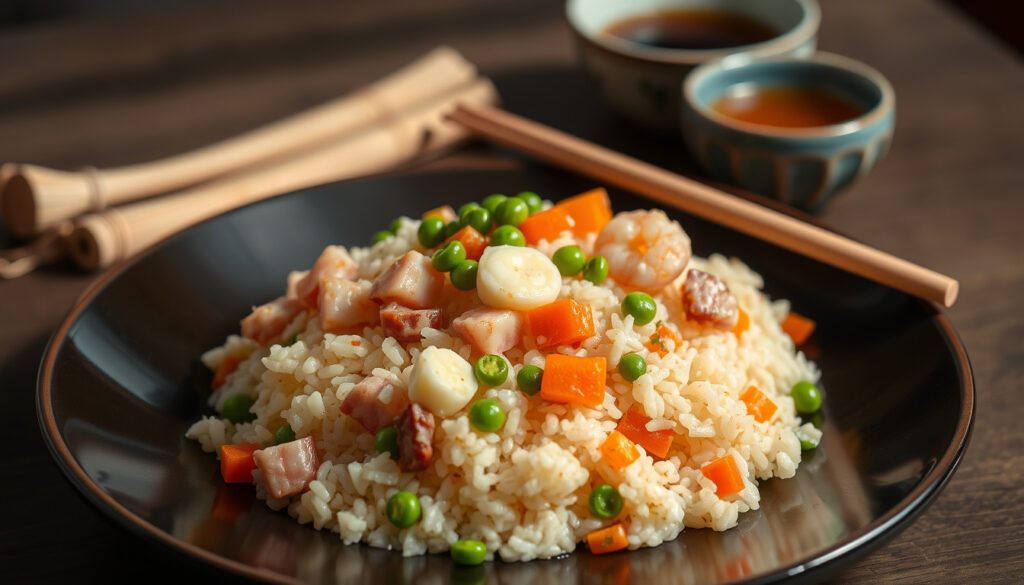
- The dish is defined by its mix of proteins: pork (often ham or char siu), shrimp, and scrambled egg — at least two proteins are required.
- Vegetables such as peas, carrots, and scallions add color and texture.
- Day-old rice is preferred because it fries up fluffy and separate, not sticky.
How it differs from plain fried rice
- Plain fried rice often uses leftover scraps and a single protein; Yangzhou fried rice requires deliberate ingredient prep.
- The cooking technique emphasizes high heat wok cooking to achieve wok hei — that smoky “breath of the wok” — which ordinary fried rice may not prioritize (YouTube tutorial).
The implication: this dish demands intention from the start, not just whatever is in the fridge.
What’s the difference between fried rice and Yangzhou fried rice?
Two styles, one core difference: Yangzhou fried rice demands intentional protein variety and precise wok technique, while ordinary fried rice is whatever you have on hand.
| Aspect | Yangzhou fried rice | Ordinary fried rice |
|---|---|---|
| Protein count | At least 2 (pork/char siu + shrimp + egg) | Often 1 (egg or some leftover meat) |
| Rice prep | Day-old jasmine or long-grain rice preferred | Any cooked rice, often fresh |
| Vegetables | Peas, carrot, scallion (consistent) | Whatever is in the fridge |
| Wok hei | Intentionally developed with high heat | Rarely attempted |
| Origin | Yangzhou, Jiangsu (or Guangzhou, disputed) | Pan-Chinese, no fixed origin |
The pattern is clear: the Yangzhou version is a defined recipe, not a freeform dish. The trade-off is that you need to plan ahead.
If you order “fried rice” at a Chinese restaurant and expect the multi-protein, smoky version, you’re probably thinking of Yangzhou fried rice. Standard fried rice is cheaper and faster, but rarely as satisfying.
The pattern: the label on the menu tells you which standard to expect.
Why is Yangzhou fried rice famous?
Historical significance
- It is one of the most iconic fried rice dishes in China, often served at banquets and celebrations.
- Its association with Qing official Yi Bingshou gave it a prestige boost in the 18th century.
Government endorsement
- In 2008, the Chinese government published an official recipe for Yangzhou fried rice, standardizing the ingredients and method.
- This rare official seal elevated the dish from folk staple to cultural heritage item.
Global popularity
- Through the Chinese diaspora, it became a fixture on menus from San Francisco to Singapore.
- Its balanced flavor — savory pork, sweet shrimp, fluffy egg, and crisp vegetables — appeals to nearly all palates.
The government recipe gave the dish an official identity, making it harder for cheaper imitations to claim the name. For consumers, that means the “Yangzhou” label on a menu should promise a specific standard.
What this means: the name itself now carries regulatory weight, not just culinary tradition.
Is Yangzhou fried rice healthy?
Calorie and macronutrient profile
- A typical serving (about 1.5 cups) contains 380–420 calories.
- Protein comes from pork, shrimp, and egg — roughly 20–25g per serving.
- Carbohydrates from two cups of cooked rice add about 80g carbs.
Sodium and oil considerations
- The dish uses 2 tbsp light soy sauce and 0.5 tsp salt in the typical recipe.
- Wok frying adds oil; total fat can reach 15–20g per serving.
- Sodium can exceed 800mg if extra soy sauce is added.
How to make a lighter version
- Use brown rice, reduce soy sauce and oil by half, and add more vegetables like bell pepper or broccoli.
- Replace char siu with lean chicken breast or tofu to lower saturated fat.
The catch: portion control matters more than ingredient swaps for keeping this dish in a balanced diet.
What makes Yangzhou fried rice?
Essential ingredients
- Core: day-old jasmine rice, eggs, char siu (or ham), shrimp, peas, carrot, scallion.
- Traditional versions may also include chicken, sea cucumber, bamboo shoots, and scallops.
- Jinhua ham is the preferred pork ingredient in authoritative recipes.
The role of wok hei
- Wok hei — the characteristic smoky flavour from heating oil and seasonings in a screaming hot wok — is essential.
- Without it, the dish lacks the depth that distinguishes it from home-style fried rice.
Traditional vs modern variations
- Two cooking techniques exist: “silver over gold” (fry eggs first, then add rice) and “gold over silver” (rice first, then eggs) (YouTube video).
- Modern home versions often skip optional proteins like sea cucumber for convenience.
Step-by-step preparation
- Cook 2 cups of rice a day ahead and refrigerate uncovered to dry out.
- Dice 5 oz char siu or ham, peel 4 oz shrimp, and chop scallion, carrot, and peas.
- Beat 2 eggs and scramble in a hot wok with 1 tbsp oil. Remove and set aside.
- Add 1 tbsp oil to wok, stir-fry char siu and shrimp until cooked. Remove.
- Add remaining oil, spread day-old rice in wok, pressing and tossing to heat through.
- Pour 2 tbsp light soy sauce and 0.5 tsp salt over rice, toss to coat.
- Return all proteins, add vegetables, and toss. Finish with scallion.
- Serve immediately — the wok hei fades fast.
Day-old rice is non-negotiable. Using freshly cooked rice will produce a sticky, clumpy mess — even the best ingredients won’t save it.
Confirmed facts
- Created in Yangzhou during the Qing dynasty
- Traditional proteins: ham, shrimp, egg
- Official recipe published by Chinese government in 2008
What’s unclear
- Exact inventor of the dish is unknown
- Whether it originated as street food or palace cuisine
- Whether the dish truly started in Yangzhou or Guangzhou
“Yangzhou fried rice is believed to have been created during the Qing dynasty in Yangzhou, Jiangsu.”
— Wikipedia (online encyclopedia)
“The core ingredients in a traditional Yangzhou fried rice recipe are generally pork, shrimp, vegetables, and eggs.”
— Made With Lau (home cooking blog)
For home cooks in Singapore and beyond, the choice is clear: seek out day-old rice and quality proteins, or risk a pale imitation of the original. The official government recipe provides a benchmark, but the best Yangzhou fried rice will always come from a wok that’s hot enough to deliver that elusive wok hei.
The dish’s storied history and signature ingredients are explored in more depth through a look at authentic Chinese fried rice origins.
Frequently asked questions
What is the official recipe for Yangzhou fried rice?
The Chinese government published a standard in 2008 specifying day-old rice, Jinhua ham, shrimp, scrambled egg, peas, carrot, scallion, and seasonings like light soy sauce. Exact proportions vary, but the core ingredients are fixed.
Can I use leftover rice for Yangzhou fried rice?
Yes — in fact, day-old rice is strongly recommended. Freshly cooked rice is too moist and will result in a clumpy texture.
What type of rice is best for Yangzhou fried rice?
Jasmine or long-grain rice is traditional. Short-grain rice becomes too sticky.
Is Yangzhou fried rice gluten-free?
It can be, if you use tamari or coconut aminos instead of soy sauce (which contains wheat). Check that the char siu is also gluten-free.
How should I store leftover Yangzhou fried rice?
Cool quickly and refrigerate in an airtight container for up to 3 days. Reheat in a wok or pan to restore some texture.
What vegetables are traditionally used in Yangzhou fried rice?
Peas (or snow peas), diced carrots, and scallions. Some recipes add bamboo shoots or shiitake.
Can I make Yangzhou fried rice without pork?
Yes — substitute chicken, turkey, extra shrimp, or tofu. The dish adapts well, though purists insist on ham.
How long does it take to cook Yangzhou fried rice?
About 30 minutes active time, plus rice cooling overnight. The cooking itself is fast — 5–7 minutes over high heat.
More related posts
 Home Team Career Centre fire: 20 evacuated, 1 hospitalized
 UOB Exchange Rate Singapore: Today’s SGD to USD, MYR, THB Rates
 Hup San Social Club: Singapore’s Pocket-Sized Nightlife Hideaway
 Bintan Pearl Beach Resort: Location, Costs & Getting There
 2025 Singapore General Election Rallies: Final Day Sites
 H&M Singapore: Online Shopping, Stores & App Guide
 The Assembly Place IPO: Price, Date & Debut Performance
 Thailand Open Badminton 2025: Schedule, Tickets, Results