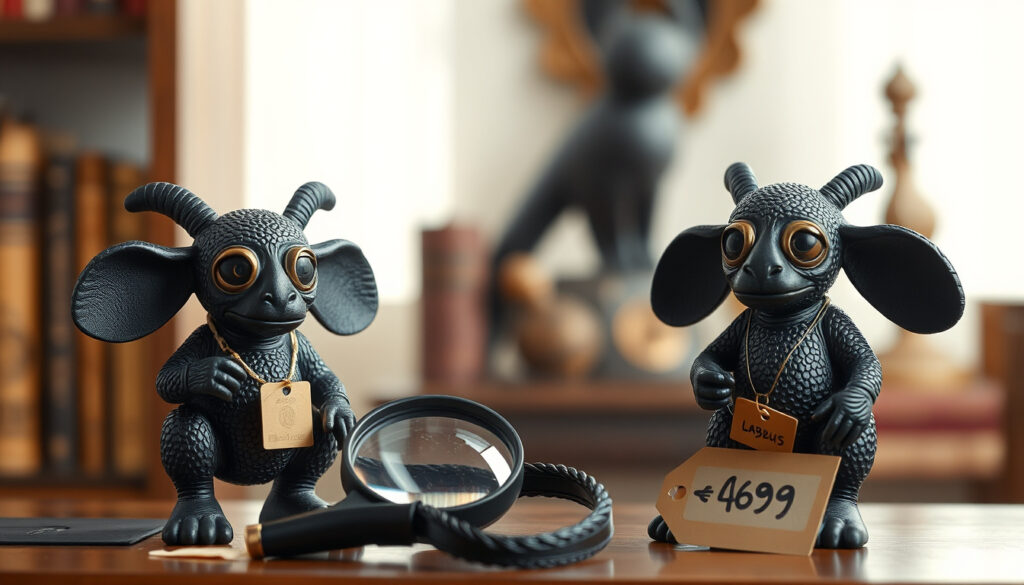
Labubu Hide and Seek: Rarity, Fakes, and Value Guide
For collectors of Pop Mart’s Labubu series, the “Hide and Seek” plush from Singapore is a holy grail — and a minefield of counterfeits. Released exclusively on the island city-state, this vinyl doll has sparked a resale frenzy that can leave even seasoned collectors wondering if what they’re holding is the real deal. Here’s everything you need to know about its rarity, how to spot a fake, and whether it’s worth the hunt.
Retail price (Pop Mart Singapore): S$37.90 ·
Resale price range (eBay): $69.00 – $74.95 ·
Product dimensions: 10 × 10 × 17.5 cm ·
Release type: Limited edition, Singapore exclusive ·
Material: Vinyl plush doll pendant
Quick snapshot
- Singapore-exclusive limited edition (Marching Dogs authentication guide)
- Vinyl plush doll pendant (Marching Dogs authentication guide)
- Features Merbubu mermaid variant (Marching Dogs authentication guide)
- Check for Pop Mart hologram and QR code (Art Toy Familia authentication guide)
- Verify blue tag and font details (Art Toy Familia authentication guide)
- Compare stitching and materials (Art Toy Familia authentication guide)
- Limited to Singapore market (Jane Blog collector insights)
- Resale price 2-3x retail (Jane Blog collector insights)
- Highly sought by collectors (Jane Blog collector insights)
- Pop Mart Singapore official store (Marching Dogs buying tips)
- StockX and eBay resale market (Marching Dogs buying tips)
- Avoid unofficial retailers (Marching Dogs buying tips)
Six snapshot facts, one pattern: the Hide and Seek series is defined by its exclusivity — every detail reinforces that this is a Singapore-only collectible with premium materials and a dedicated resale market.
| Attribute | Value |
|---|---|
| Official Name | LABUBU HIDE AND SEEK IN SINGAPORE SERIES |
| Retailer | Pop Mart Singapore |
| Material | Vinyl plush |
| Dimensions | 10 × 10 × 17.5 cm |
| Retail Price | S$37.90 |
| Exclusivity | Singapore only |
What is the rarest Labubu figure?
Within the Labubu universe, the Hide and Seek Merbubu — a mermaid variant exclusive to Singapore — sits at the top of most collectors’ wish lists. Its regional lock means far fewer units exist than standard blind-box releases, and that scarcity has pushed resale prices sharply higher.
Which Labubu figures are most sought after?
- The Hide and Seek Merbubu (Singapore exclusive)
- The original Mokoko and early series figures
- Limited edition collaborations (e.g., artist Kasing Lung’s original works)
- Figures from the first “Have a Seat” series in certain variants (Art Toy Familia rarity guide)
The Merbubu mermaid and other grails
The Merbubu stands out not just for its mermaid tail design but because Pop Mart Singapore marketed it as a limited run for the city-state’s flagship store. Reports from collectors on platforms like Lemon8 (user @my_lalabubu) describe it as “impossible to find at retail” within weeks of release.
How rarity affects value
According to Legit App’s authentication guide, region-locked Labubu figures like Hide and Seek carry a multiplier on the secondary market: retail S$37.90 turns into $69–$75 on eBay, and the Merbubu variant can go higher. The pattern is consistent across limited-edition collectibles: exclusivity fuels demand, demand lifts price.
Singapore collectors face a 2–3× markup on a figure that was already priced as a premium pendant. For anyone not in Singapore, buying from resale is the only route — and that means trusting authentication.
How to tell if Hide and Seek Labubu is real?
Fakes — often called “Lafufus” in the community — have flooded online marketplaces. The good news: authenticators have documented a handful of reliable tells that separate genuine Pop Mart products from counterfeits.
Check the Pop Mart hologram and QR code
Every authentic Labubu Hide and Seek box carries a laser anti-counterfeit sticker that reflects light sharply, per Zebraup’s verification guide. The QR code on the box should redirect to either fwsy.popmart.com or m-gss.popmart.com for serial number verification against Pop Mart’s database (Jane Blog authentication tips). Fakes often have a printed sticker that doesn’t reflect or a QR that leads nowhere.
Examine the tag and font details
- The hang tag on an authentic Labubu has a bold, consistent font and a lighter red color than fakes (Art Toy Familia).
- Real tags are made of a smooth plastic with a built-in QR code; fakes often use a fabric tag without a scannable code (Lemon8 user comparison).
- The wash label inside the plush feels smooth and integrated, not raised or plasticky (Legit App).
Compare to official product images
Genuine Labubu have exactly nine sharp, evenly spaced teeth (Marching Dogs). The head is compact and perfectly proportioned to the body; the fur feels like high-end plush, not coarse synthetic (Legit App). The vinyl body is smooth with no visible seams on the hands (Zebraup), and the collector card has a distinct texture and vibrant colors that fakes can’t reproduce well.
Under UV or blue light, an authentic Labubu reveals a laser-etched logo on the foot, and the eyes and teeth glow brightly — fakes lack this detail (Art Toy Familia).
Why are Labubu so expensive?
Three forces push Labubu prices upward: limited production runs, geography-specific releases, and the blind-box model that Pop Mart pioneered.
Limited production runs and regional exclusives
The Hide and Seek series was manufactured only for Singapore’s Pop Mart store. According to Marching Dogs, regional lock severely limits the total supply compared to a global blind-box wave. Collectors outside Singapore must either travel or buy on the secondary market, where scarcity commands a premium.
High demand from collectors and resale market
Pop Mart’s fan base spans Asia, Europe, and North America. When a figure is exclusive to one city, the resale ecosystem reacts quickly. Data from Jane Blog shows that Singapore-exclusive Labubu figures list on eBay at $69–$75 within weeks of launch — roughly 2 to 3 times the retail price.
Pop Mart’s blind box premium model
The blind-box mechanic itself creates artificial scarcity. Buyers purchase a sealed box and don’t know which variant they’ll get until opening. The chance of pulling the rare Merbubu adds a lottery element that inflates secondary prices for that specific variant. Collectors who want the Merbubu outright often pay a premium on resale platforms rather than gamble on multiple blind boxes.
The pattern: Pop Mart’s business model turns every exclusive release into a low-supply, high-demand event — and the aftermarket capitalises on that volatility.
Are Labubus worth money?
The short answer: some are, most aren’t. Only limited editions and region exclusives like Hide and Seek hold resale value consistently.
Investment potential of Labubu figures
Standard blind-box Labubu figures — the ones you can buy from a shelf — rarely appreciate. They’re toys, not assets. But exclusives behave differently. Data from Legit App indicates that a well-preserved Hide and Seek figure in box can sell for double its original retail. The key factors: condition, box state, and whether the Merbubu variant is inside.
Factors that increase value: rarity, condition, box
- Rarity: Singapore-only, limited to a specific retail run.
- Condition: Unopened boxes with authentic tags fetch the highest prices.
- Box completeness: Including the original collector card and dust bag adds 10–20% to resale value (Zebraup).
Market trends and liquidity
The resale market for Labubu is active but niche. Figures listed on eBay and StockX can take weeks to sell, and fakes dilute trust. Marching Dogs warns that fake Labubu have no secondary market value and are banned from major resell platforms. For investors, the takeaway is clear: only authentic, boxed exclusives are worth chasing.
The trade-off: a Hide and Seek figure bought at retail for S$37.90 can sell for $70+, but that assumes an authentic product, a willing buyer, and patience. It’s not a guaranteed profit.
How to know if a Labubu is rare?
Rarity signals are baked into the product lineage. You just need to know where to look.
Check production numbers and region exclusivity
The first clue is the series name. “Singapore Series” in the title of Hide and Seek tells you it’s a geographical exclusive. Marching Dogs notes that Pop Mart rarely reissues region-specific releases, so figures from those runs remain scarce.
Look for special editions and collaborations
- Collaborations with artists (e.g., Kasing Lung’s original designer series)
- Event-exclusive figures (e.g., pop-up store giveaways)
- Seasonal or holiday variants
- The Merbubu tail variant within Hide and Seek itself (Lemon8 collector discussion)
Verify with Pop Mart official lists
Pop Mart maintains serialized verification for many products. Scanning the QR code on the box leads to a database entry showing the figure’s origin. If the code points to m-gss.popmart.com and the serial number checks out, you have an authentic figure. If the code doesn’t resolve or the database shows a different region, the figure is either fake or a different release (Jane Blog).
The catch: Pop Mart doesn’t publish exhaustive rarity tier lists, so collectors rely on community knowledge and resale data. The best indicators are exclusivity, low production hints (e.g., “Singapore Series”), and secondary market price multipliers.
Step-by-step authentication guide
To help you avoid buying a counterfeit, here’s a practical step-by-step process based on the documented tells.
- Check the box sticker. Run your finger over the laser anti-counterfeit sticker. Real ones reflect light sharply (Zebraup).
- Scan the QR code. Point your phone camera at the QR on the box tag. It should go to
fwsy.popmart.comorm-gss.popmart.com— not a generic URL (Jane Blog). - Count the teeth. Open the plush’s mouth. You should see exactly nine sharp, evenly spaced teeth (Marching Dogs).
- Examine the tag material. The blue hang tag should be a smooth plastic with a QR code printed on it — not a fabric tag (Lemon8 comparison).
- Feel the fur and vinyl. Authentic plush is dense and soft; the vinyl body has no visible seams on the hands (Legit App).
- Check the feet under UV. Shine a UV or blue light on the bottom of the right foot. A laser-etched Pop Mart logo should appear (Art Toy Familia).
- Verify the collector card. The paper card should have a distinct texture and vibrant colors — fakes often look washed out or feel thinner (Zebraup).
The implication: authentication takes about two minutes once you know what to check. For a figure that costs $70 on the secondary market, those two minutes are the difference between a grail and a $70 mistake.
Confirmed facts vs. what’s unclear
Confirmed facts
- Retail price S$37.90 at Pop Mart Singapore
- Merbubu mermaid variant exists within the series
- Blue hang tag with QR code to official verification site
- Nine sharp teeth on authentic figures
- UV-reactive stamp on the right foot
- Resale price range of $69.00 – $74.95 on eBay
What’s unclear
- Exact production numbers — Pop Mart hasn’t disclosed quantity
- Whether a reissue or restock will ever occur
- Official step-by-step authentication guide from Pop Mart itself
- Full list of all Hide and Seek variants beyond Merbubu
- Whether the laser-etched logo is present on all production runs
- Whether the QR code domain is consistent across all Pop Mart products
The trade-off: verified details give collectors confidence, but open questions mean the hunt still requires due diligence.
What collectors are saying
Two perspectives highlight the tension between retail value and aftermarket reality.
“LIMITED EDITION … Vinyl Plush Doll Pendant.”
— Pop Mart product page (Pop Mart official site)
“Fake Labubu have no secondary market value and are banned from major resell platforms. Always verify before you buy.”
— Marching Dogs authentication guide (Marching Dogs (community authentication platform))
“If you see a Labubu with a fabric tag that says ‘Labubu’ in a thin font and no QR code — it’s a Lafufu.”
— Lemon8 user @my_lalabubu (Lemon8 (collector community post))
“Authentic Labubu have exactly nine sharp, evenly spaced teeth. Count them — it’s one of the easiest tells.”
— Marching Dogs authentication guide (Marching Dogs (community authentication platform))
The consensus from the community: authentication isn’t optional — it’s the only way to avoid paying premium prices for counterfeits with zero value.
Summary
The Labubu Hide and Seek series is a textbook case of regional exclusivity driving collector demand and resale prices. But that same demand has spawned a wave of convincing fakes that only a careful authentication process can catch. For the average collector in Singapore, buying directly from the Pop Mart store at S$37.90 is the safest bet — but the figure sells out fast. For international buyers, the resale market at $69–$75 asks a premium that demands thorough verification. The trade-off is clear: get the authentication right, and you own a grail; skip the checks, and you’re out $70 with a Lafufu.
For Build A Bear Singapore customers and toy enthusiasts who enjoy collecting plush companions, the same rule applies: always verify before you buy. And if you’re hunting for the Merbubu, consider visiting Pet Store Near Me Singapore for local toy shop leads — sometimes the most elusive figures turn up in unexpected places.
For collectors interested in other popular Labubu releases, the Have a Seat Labubu series offers a similar deep dive into rarity and authenticity.
Frequently asked questions
Is Labubu a girl or guy?
Labubu is a male character created by Belgian artist Kasing Lung. The character’s gender is established as male in the original art series.
What is the blue tag on Labubu Hide and Seek?
The blue hang tag with a Pop Mart logo and scannable QR code is a hallmark of authentic Hide and Seek figures. It links to Pop Mart’s verification system. Fake figures often replace this with a fabric tag without a QR code.
Can I buy Labubu Hide and Seek outside Singapore?
Not at retail. The series was an in-store exclusive for Pop Mart Singapore. International buyers must purchase from resale platforms like eBay or StockX, where prices range from $69 to $75 USD.
How many versions of Labubu Hide and Seek exist?
Pop Mart has not published a complete list. Collectors have documented at least two main variants: the standard Hide and Seek plush and the Merbubu (mermaid) variant. Other subtle variations may exist in production batches.
What does Merbubu mean?
“Merbubu” is a portmanteau of “mermaid” and “Labubu.” It refers to the variant of the Hide and Seek plush that features a mermaid-like tail instead of legs.
How do I clean my Labubu plush?
Spot clean with a damp cloth and mild soap. Avoid machine washing or submerging the vinyl body, as water can damage the internal structure and UV-reactive stamp.
Are there any known Labubu Hide and Seek reissues?
As of now, Pop Mart has not announced a reissue of the Singapore-exclusive series. Given the “Singapore Series” wording, a reissue is unlikely without reopening the original retail arrangement. Buyers should assume the current stock is the only release.
More related posts
 Cream of Mushroom Soup – Simple Recipe and Variations
 Forex Awards Best Forex Nominations: Global Awards & Stats
 Yangzhou Fried Rice: Hi tory, Recipe, Difference
 DBS Bank Branches Operating Hours Guide: Singapore
 LKC School of Medicine: Rankings & Key Facts
 Cast of Havoc (2025 Film) – Stars, Roles and Production Facts
 Cast of Blood Brothers Bara Naga – Actors and Characters Guide
 Women in STEM Fields: Stats, Jobs & Pioneers