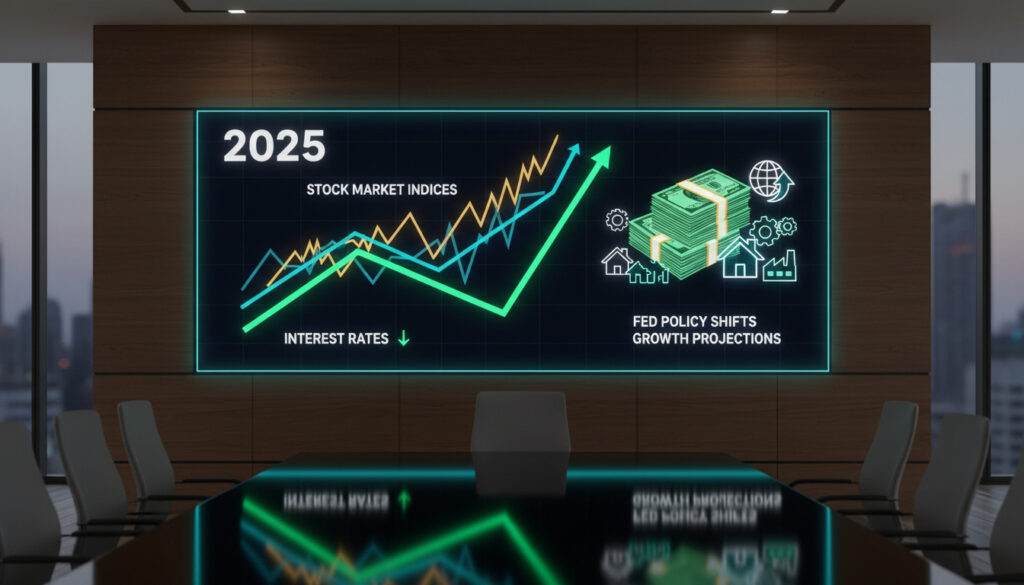
Fed Rate Cuts 2025 – Timeline, Projections and Key Impacts
The Federal Reserve implemented two interest rate reductions in 2025, lowering the federal funds rate from 4.50%-4.75% to 3.50%-3.75% by year-end. Policymakers executed 25-basis-point cuts in September and December amid cooling labor conditions and moderating inflation pressures.
Following the December reduction, the Federal Open Market Committee adopted a wait-and-see posture, holding rates steady through early 2026. Projections released in March 2026 indicate most officials anticipate only one additional cut this year, potentially bringing the target range to 3.25%-3.50% by December.
The policy trajectory reflects persistent uncertainty regarding tariff impacts, sticky inflation components, and the unemployment rate’s settling point. Fed Chair Jerome Powell has emphasized that further easing depends on significant labor market deterioration, with the current stance perceived as near neutral.
Will the Fed Cut Rates in 2025?
- The FOMC reduced the federal funds rate by 50 basis points across two meetings in 2025, with the first cut occurring in September.
- September’s reduction followed four years of elevated unemployment, which reached 4.3% that month alongside manifest softening in labor demand.
- Three officials dissented at the December meeting, opposing what they viewed as unnecessary easing as the policy rate approached neutral.
- The March 2026 dot plot reveals 14 of 19 FOMC participants expect no more than one additional cut in 2026.
- J.P. Morgan analysts project rates holding steady at 3.5%-3.75% throughout 2026, with potential rate hikes returning in 2027.
- Fed Chair Powell indicated job growth data overstated underlying gains by approximately 60,000 positions monthly.
| Metric | Value |
|---|---|
| Current Federal Funds Rate | 3.50%-3.75% |
| September 2025 Meeting | Cut 25 bps (to 4.00%-4.25%) |
| December 2025 Meeting | Cut 25 bps (to 3.50%-3.75%) |
| Total 2025 Reduction | -50 basis points |
| December Dissenters | 3 members |
| Unemployment Rate (Sept 2025) | 4.3% |
| End-2026 Projection | 3.25%-3.50% |
| Long-Run Neutral Rate | 3.125% |
How Many Fed Rate Cuts Were Implemented in 2025?
The Federal Reserve executed precisely two rate reductions during 2025, marking a measured pivot from the restrictive policy stance maintained throughout the previous year. The first adjustment occurred in September, followed by a final reduction in December that brought the target range to 3.5%-3.75%.
The September Decision
On September 17, 2025, the FOMC voted 11-1 to lower the federal funds rate by 25 basis points to a range of 4.00%-4.25%. Governor Stephen Miran dissented, favoring a larger 50-basis-point reduction. Meeting materials indicate the cut responded to unemployment reaching 4.3%, its highest level in four years, alongside manifest softening in labor demand.
The December Adjustment
The committee delivered its second 25-basis-point cut on December 18, 2025, lowering the rate to 3.5%-3.75%. This decision attracted three dissenters who preferred maintaining higher rates. Invesco analysis notes the reduction occurred despite sticky inflation readings, with policymakers judging the rate as approaching neutral levels.
The Summary of Economic Projections includes anonymous individual assessments from 19 FOMC participants—both voting and non-voting members—regarding the appropriate federal funds rate path. These projections, visualized as dots on a chart, do not represent official committee consensus but rather the distribution of personal views.
Post-December Pause
Following the December reduction, the FOMC maintained rates at 3.5%-3.75% through subsequent meetings, including a second consecutive pause observed in early 2026. Schwab’s examination of policy statements reveals officials adopted explicit wait-and-see language, conditioning future moves on labor market weakening beyond current conditions.
What Is the FOMC Meeting Schedule for 2025?
The Federal Open Market Committee convened eight times during 2025, with four sessions featuring the quarterly Summary of Economic Projections that include the closely watched dot plot matrix.
Quarterly Projection Meetings
Policy projections were released in conjunction with meetings held in March, June, September, and December. These sessions provide the official dot plot visualizations mapping individual members’ rate expectations across three-year horizons plus long-run estimates.
Key 2025 Decision Dates
While the committee meets every six weeks, the September 17 and December 18 meetings delivered the year’s only rate reductions. Official projections published after the December gathering showed the median 2026 estimate at 3.25%-3.50%, implying one additional cut.
Market Reaction Timing
Policy announcements typically release at 2:00 p.m. Eastern Time on meeting Wednesdays, with Chair Powell press conferences following 30 minutes later for quarterly meetings. The March 2026 dot plot, released subsequent to the current analysis period, displayed increased clustering around minimal 2026 cuts.
How Will Fed Rate Cuts Impact Mortgages and Stocks?
The 2025 rate reductions transmitted through financial markets with varying velocity, affecting mortgage borrowers differently than equity investors depending on timing and duration expectations.
Housing Market Effects
The September and December cuts provided modest relief for adjustable-rate mortgage holders and new homebuyers, though 30-year fixed rates responded with typical lag to Treasury yield fluctuations. With the Fed now on hold, mortgage markets have stabilized near mid-2025 levels, removing refinancing urgency for many homeowners.
Stocks initially rallied on the neutral policy stance, as removal of restrictive financial conditions supported valuation multiples. However, Invesco strategists caution that sticky inflation could pressure equities if the Fed maintains higher-for-longer positioning indefinitely.
Broader Economic Implications
The cumulative 50-basis-point reduction, combined with forward guidance suggesting minimal 2026 easing, supports GDP growth forecasts slightly above prior estimates while managing inflation risks. J.P. Morgan economists observe the economy has reached equilibrium between slower labor supply and demand, though tariff uncertainty remains an unquantified variable.
Some FOMC projections and external forecasts, including J.P. Morgan’s baseline scenario, anticipate potential rate hikes returning in 2027 if labor markets tighten unexpectedly or inflation reaccelerates toward 4%.
When Is the Next Fed Rate Decision?
The FOMC operates on a published calendar with eight scheduled meetings annually. Following the December 2025 reduction, the committee maintained rates through the first quarter of 2026. For those looking to manage their video files efficiently, you can explore free video compressors 2025.
- : FOMC cuts rates 25 bps to 4.00%-4.25%; dot plot suggests two additional cuts possible in 2025. Source
- : Second 25 bps cut to 3.50%-3.75%; three dissenters; neutral rate assessment. Source
- : Rates held steady at 3.50%-3.75%; first pause. Source
- : Dot plot released showing 14 of 19 members projecting no more than one cut in 2026. Source
- : Potential single cut to 3.25%-3.50% if labor markets soften significantly.
- : Rates potentially reaching low-3% range or facing upward pressure depending on labor market dynamics. Source
Will the Fed Cut Rates Again in 2026?
Projections indicate limited additional easing this year, though uncertainty surrounds the exact timing and necessity of further cuts.
Established
- Rates held at 3.5%-3.75% since December 2025
- 14 of 19 FOMC members expect zero or one cut in 2026
- Unemployment remains elevated but stable near 4.3%
- Policy rate perceived as approaching neutral
Uncertain
- Specific timing of potential 2026 cut
- Magnitude of tariff impacts on consumer prices
- Whether job growth deceleration accelerates
- Possibility of 2027 rate hikes if labor tightens
What Factors Could Influence Fed Rate Decisions?
The Federal Reserve’s 2025 pivot toward accommodation responded to specific labor market deterioration signals, while the subsequent pause reflects inflation persistence and neutral rate uncertainty. How Many Countries Are There in the World – 195 Sovereign States Explained
Powell’s September 2025 remarks explicitly cited tariff uncertainty alongside labor softening. The committee’s December caution stemmed from recognition that monthly job gains were overstated by approximately 60,000 positions, masking underlying weakness that nonetheless failed to trigger recessionary protocols.
The neutral rate—the theoretical interest rate neither stimulating nor restricting growth—has drifted upward in Fed estimates to 3.125%, suggesting less room for additional cuts without becoming stimulative. This elevation reflects structural changes in labor force participation and productivity trends that have emerged since the pandemic era.
What Are Fed Officials Saying About Rate Policy?
Labor demand has softened… unemployment rate rose to 4.30%… I can no longer say the labor market is very solid.
— Jerome Powell, September 2025 Press Conference. Source
The committee judged that the policy rate had moved close to neutral, with future reductions contingent upon significant labor market deterioration.
— FOMC Statement, December 2025
Key Takeaways on Federal Reserve Policy
The Federal Reserve delivered two 25-basis-point rate cuts in 2025, lowering the federal funds rate to 3.5%-3.75%, where it remains through early 2026. Officials project minimal additional easing this year, with most anticipating one further reduction at most, as policymakers navigate sticky inflation readings and tariff uncertainty while seeking to avoid unnecessary economic restriction. Zone of Proximal Development – Vygotsky’s Theory Explained
Frequently Asked Questions
What is the current fed funds rate?
As of early 2026, the federal funds rate target range stands at 3.50%-3.75%, following 25-basis-point cuts in September and December 2025.
What is the Fed dot plot for 2025?
The December 2025 dot plot showed the median federal funds rate at 3.50%-3.75% for year-end, with projections for 3.25%-3.50% by end of 2026.
Will Fed rates go down in March 2025?
The Federal Reserve maintained rates steady during March 2025. The first reduction of 2025 occurred in September, not March.
Fed projections vs market expectations
The March 2026 dot plot aligns closely with market pricing, both anticipating rates holding near 3.5%-3.75% through mid-2026 with one possible cut by year-end.
Fed rate cut history and patterns
The 2025 cuts followed a historical pattern of easing during labor market softening, though the pace was slower than previous cycles given persistent inflation components.
More related posts
 How to Cancel ChatGPT Subscription: Web, iPhone, Mac
 Singapore Currency Rate in India: Live SGD to INR
 The Theatre at Mediacorp: Capacity, Seating & Location
 Ngee Ann City Parking Rate: Guide & Cheap Alternatives
 ETS KL to JB – Timetable, Fares and Booking Guide
 TikTok Video Download Without Watermark: Top Free Tools
 East Coast GRC WP: History, Maps, MPs & Contact for GE2025
 Labubu Hide and Seek: Rarity, Fakes, and Value Guide