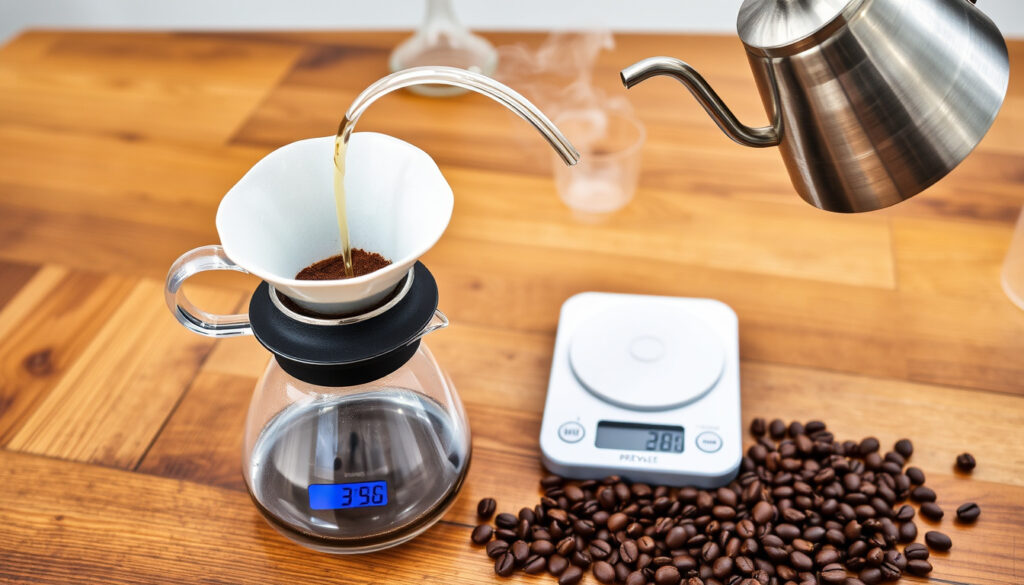
How to Brew Pour Over Coffee: Ratio, Mistakes & Tips
Anyone who’s tried making pour-over coffee at home knows the feeling: a cup that tastes bright and clean one morning, then bitter or weak the next. The difference usually comes down to a handful of variables—ratio, temperature, technique. This guide breaks down the most reliable ratios, common mistakes, and a practical step-by-step method so you can dial in a consistently great cup.
Recommended water temperature: 195-205°F (90-96°C) ·
Standard coffee-to-water ratio: 1:16 (1 gram coffee per 16 ml water) ·
Common brew time (12-20g dose): 3-4 minutes ·
Gold cup standard (SCA): 1.15-1.35% TDS
Quick snapshot
- Standard: 1:16 (coffee:water by weight) (Goldberry Roasting (specialty roaster))
- Golden ratio: 55g coffee per 1L water (Coffee Chronicler (brewing resource))
- For 1 cup (8 oz): 15g coffee, 240g water (Pull & Pour Coffee (coffee educator))
- Optimal range: 195-205°F (90-96°C) (Stone Creek Coffee (roaster & educator))
- Let boiling water sit 30-60 seconds (Merit Coffee Co. (specialty roaster))
- Medium-coarse like sea salt (Coffee Chronicler (brewing resource))
- Finer for more body, coarser for cleaner cup (Coffee Chronicler)
- Pour 2x coffee weight in water (Goldberry Roasting (specialty roaster))
- Wait 30-45 seconds (Stone Creek Coffee (roaster & educator))
- Essential for degassing (Stone Creek Coffee)
Five key parameters define a good pour-over. Here they are at a glance, with sources.
| Parameter | Value | Source |
|---|---|---|
| Standard ratio | 1:16 (coffee to water by weight) | Goldberry Roasting |
| Golden ratio | 55g coffee per 1L water | Coffee Chronicler |
| Recommended water temp | 195-205°F (90-96°C) | Stone Creek Coffee |
| Bloom time | 30-45 seconds | Goldberry Roasting |
| Total brew time (12-20g) | 3-4 minutes | Goldberry Roasting |
What is the correct ratio of coffee to water for pour over?
Understanding the 1:16 standard ratio
- The 1:16 ratio (1 gram coffee to 16 grams water) is the most widely recommended starting point for pour-over. Goldberry Roasting (specialty roaster) uses it as their baseline.
- Merit Coffee Co. (specialty roaster) also calls 1:16 their standard, exemplifying with 25g coffee to 400g water.
- Pull & Pour Coffee (coffee educator) uses 20g coffee and 320g water—again a 1:16 ratio.
The ratio is the single biggest lever you can pull to control strength. A 1:15 gives a bolder cup; 1:17 produces a brighter, lighter brew. Stick with 1:16 first, then adjust.
Golden ratio versus standard ratio
The term “golden ratio” is sometimes used interchangeably with “standard ratio,” but it more precisely refers to 55g of coffee per 1 liter of water—roughly 1:18. Coffee Chronicler (brewing resource) describes this as a benchmark for mild-bodied coffee, while the 1:16 standard (55g per 880ml) yields a slightly stronger cup. Stone Creek Coffee (roaster & educator) notes that 16:1 (water to coffee) is balanced, and 15:1 is bolder, 17:1 brighter. The implication: there’s no single “golden” number—the best ratio depends on your taste and bean.
Ratio by tablespoons for common cup sizes
Without a scale, use volume as a rough guide. A tablespoon of ground coffee weighs about 5–7g. For a 6-oz cup (180ml), Stone Creek Coffee (roaster & educator) suggests about 2 tablespoons (10–14g). For an 8-oz cup (240ml), use about 3 tablespoons (15–20g). But weight is always more consistent.
The pattern: ratio shifts by personal preference, but starting at 1:16 gives you a repeatable baseline to adjust from. The catch is that volume-based measurements introduce error—a scale removes the guesswork.
What are common mistakes in pour over coffee?
Incorrect grind size
- Too fine a grind leads to over-extraction and bitterness. Goldberry Roasting (specialty roaster) recommends grinding coarser if coffee tastes bitter.
- Too coarse yields sour, weak coffee—grind finer to fix. Coffee Chronicler (brewing resource) specifies medium-fine as the target.
Water temperature errors
- Water off-boil (212°F) is too hot and can scorch grounds. Stone Creek Coffee (roaster & educator) advises heating water to 200°F.
- Below 195°F, extraction slows and the cup may taste flat.
Pouring technique mistakes
- Pouring too fast or too slow affects extraction time. Stone Creek Coffee (roaster & educator) instructs brewers to pour in small steady circles, avoiding the filter walls.
- Pull & Pour Coffee (coffee educator) says start in the center and work outward to saturate grounds evenly.
Bloom phase neglect
- Skipping the bloom yields uneven extraction. Goldberry Roasting (specialty roaster) recommends 2–3 times the coffee weight in water, waiting 30–45 seconds.
- Merit Coffee Co. (specialty roaster) blooms 50g water for 25g coffee at 0:00–0:30.
Every mistake pushes the brew toward under- or over-extraction. The home barista who dials in grind size, temperature, and pour speed within the same session will see immediate improvement in clarity and sweetness.
The implication: these four variables interact. Fixing one can mask another, so change only one parameter per brew to isolate the effect.
What is the 15-15-15 coffee rule?
Explanation of the 15-15-15 rule
The 15-15-15 rule is a timing method some baristas use for consistent extraction: pour for 15 seconds, wait 15 seconds, pour for 15 seconds, and repeat until the target water is added. It’s not a scientific standard, but it provides a simple rhythm. Coffee Chronicler (brewing resource) doesn’t endorse it explicitly, but it aligns with their emphasis on controlled, pulsed pours.
How it impacts brewing time
- Using 15-15-15 extends total brew time to about 3 minutes for a standard 320g recipe—within the 3–4 minute target.
- The method is anecdotal; Goldberry Roasting (specialty roaster) and others emphasize consistent flow rate over rigid timing.
What this means: the 15-15-15 rule is a training wheel. Once you develop a feel for the pour, you’ll naturally modulate speed.
How to make pour over coffee with or without a scale?
Using a scale for precision
- A scale allows you to replicate recipes. Merit Coffee Co. (specialty roaster) calls skipping the scale a common mistake because measuring by eye encourages bad habits.
- For a 1:16 ratio with a scale: weigh beans (e.g., 25g), grind, wet filter, add grounds, tare, then pour water until scale reads 400g.
Measuring without a scale
- 1 tablespoon whole bean ≈ 5–7g. For an 8-oz cup, use 3 level tablespoons.
- iKoffy (coffee blog) warns that scoops are inconsistent—a scale costs as little as $15 and pays off quickly.
Step-by-step pour over instructions for beginners
- Boil water and let it sit 30–60 seconds to reach 200°F. (Stone Creek Coffee (roaster & educator))
- Rinse the paper filter with hot water to remove paper taste and preheat the dripper. (Merit Coffee Co.)
- Grind coffee medium-fine (texture of sea salt). Measure 15g for a single cup or 25g for a double.
- Place grounds in filter, tare scale (or note volume).
- Bloom: pour 2–3x the coffee weight in water (e.g., 50–75g for 25g coffee). Wait 30–45 seconds. (Goldberry Roasting)
- Main pour: slowly add remaining water in concentric circles, starting from the center out. Keep the water level below the rim. Total time per pour: steady stream for 15–20 seconds, then pause. Repeat until you hit target weight (e.g., 400g total). (Pull & Pour Coffee)
- Target total brew time: 3–4 minutes. If it finishes faster, grind finer; if slower, grind coarser. (Goldberry Roasting)
- Swirl and serve: give the carafe a gentle swirl to combine the brew, then pour.
The steps above provide a repeatable method; dialing in each variable will refine consistency. For related coffee preparations, explore The Food Peeps Coffee and Deli Menu and Yangzhou Fried Rice: History, Recipe, Difference.
Pour over brewing specifications
Six specifications, one pattern: every parameter is a lever that affects extraction yield.
| Parameter | Recommended Value | Source |
|---|---|---|
| Coffee-to-water ratio | 1:16 (1g coffee : 16g water) | Goldberry Roasting |
| Water temperature | 195–205°F (90–96°C) | Stone Creek Coffee |
| Grind size | Medium-fine (like sea salt) | Coffee Chronicler |
| Bloom ratio | 2–3x coffee weight in water | Goldberry Roasting |
| Bloom time | 30–45 seconds | Merit Coffee Co. |
| Total brew time (15–25g dose) | 3–4 minutes | Goldberry Roasting |
| Recommended dose for 1 cup (8 oz) | 15g coffee → 240g water | Pull & Pour Coffee |
The takeaway: changing any single spec without adjusting the others will shift the cup. Use this table as your starting reference, then experiment.
Confirmed facts & what’s unclear
Confirmed facts
- The 1:16 ratio is the generally accepted standard from specialty coffee sources. (Goldberry Roasting, Merit Coffee Co., Pull & Pour Coffee)
- Water temperature of 195–205°F is recommended by Stone Creek Coffee and aligns with SCA guidelines.
- The bloom phase improves extraction consistency. (Multiple sources)
- Filter rinsing removes paper taste. (Stone Creek Coffee)
What’s unclear
- Optimal ratio varies by personal taste; 1:16 to 1:18 is a common range.
- The 15-15-15 rule is anecdotal, not scientifically established.
- Exact impact of different pour speeds on extraction hasn’t been standardized.
- There is no single ‘golden’ ratio; the best ratio depends on taste and bean.
This uncertainty means personal experimentation is essential to find your ideal cup.
Expert perspectives
The Specialty Coffee Association’s Gold Cup standard targets a TDS of 1.15–1.35%, which corresponds to a 1:16 to 1:18 ratio for most brewing methods.
— Specialty Coffee Association (industry authority)
For 20g of coffee, use 60g of water for the bloom and let it sit for 45 seconds.
— Alton Brown (celebrity chef & food scientist)
Pour twice the coffee weight for the bloom to ensure even saturation.
— Perfect Daily Grind (coffee industry publication)
The implication for the home barista: the choice is clear—invest in a scale and a thermometer, or accept inconsistent results. The science of extraction isn’t complicated, but it demands precision. Those who measure will consistently outbrew those who guess.
If you are looking to upgrade your equipment, check out our picks for top-rated pour over coffee makers to complement your brewing routine.
Frequently asked questions
Can I use a metal filter for pour over coffee?
Yes. A metal filter allows more oils and fine particles through, resulting in a fuller body and more mouthfeel. Grind slightly coarser than for paper filters to avoid clogging.
Do I need to pre-wet the paper filter?
Yes. Rinsing the paper filter with hot water removes the papery taste and preheats the dripper. Stone Creek Coffee (roaster & educator) and Merit Coffee Co. both recommend this step.
How long should I wait after boiling water for pour over?
Let boiling water sit 30–60 seconds to drop to the ideal 195–205°F. Stone Creek Coffee (roaster & educator) advises 200°F as a good target.
What grind size is best for pour over?
Medium-fine, about the texture of sea salt. Coffee Chronicler (brewing resource) recommends this as the starting point. Adjust finer for more body, coarser for a cleaner cup.
Can I reuse coffee grounds for a second pour?
No. Reused grounds yield a weak, over-extracted brew with very low caffeine. Extraction of desirable compounds drops dramatically after the first brew.
Why is my pour over coffee bitter?
Bitterness usually indicates over-extraction. Common causes: water too hot (above 205°F), grind too fine, or brew time too long (past 4 minutes). Try grinding coarser or lowering water temperature. Goldberry Roasting (specialty roaster) recommends grinding coarser if coffee tastes bitter.
More related posts
 Return to Silent Hill: 2026 Horror Film Review & Facts
 Jeffrey Siow Permanent Secretary: Singapore Career Profile
 Jennifer Ang 3D Printed Fidget: Costs, Safety, Trends
 Love Bonito Warehouse Sale 2026: Dates, Discounts & Shopping Tips
 H&M Photos: Official Galleries and Zara Comparisons
 Mid Year Bonus 2024 – Payout Dates Eligibility Guide
 A3 Size in Inches – Exact Dimensions & Myths Cleared
 Web Design Trends 2025 – AI, 3D and Sustainable Design